Boxing and Injury Prevention: How to Train for Years

Research on long-term injury prevention in boxing from the British Journal of Sports Medicine is one useful source when thinking about injury prevention. England Boxing's safety standards translate this research into mandatory requirements for affiliated clubs.
Boxing has a reputation for being hard on the body. At professional and high competitive levels, that reputation is earned. But recreational boxing, trained intelligently, produces fewer injuries than many mainstream sports. The injury rate in rugby, football, and basketball is significantly higher per participant hour than recreational boxing.
The key word is intelligently. Here is what intelligent boxing training looks like in practice.
Warm Up Properly
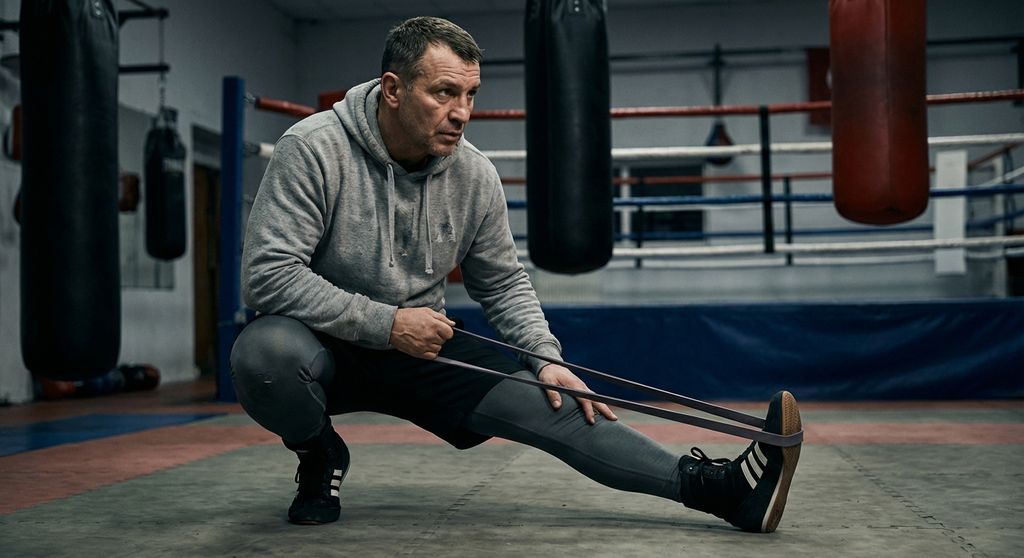
This sounds obvious but most gym injuries happen in the first twenty minutes of training when tissues are cold and joints have not been prepared. A proper warm-up is not a few arm circles and some jogging. It is ten to fifteen minutes of progressive activation.
For boxing: skipping at moderate intensity, shadow boxing at low intensity, shoulder and wrist mobility work, neck mobility, hip flexor activation. The goal is to raise your core temperature and take every joint that will be used through its range of motion before any significant load is applied.
Boxers who skip the warm-up injure their shoulders, wrists, and lower back more frequently. The correlation is direct.
Wrap Your Hands
Hand wraps are not optional for bag and pad work. They are not optional for any session that involves contact with equipment. The small bones in the hand and the tendons of the wrist are protected by wrapping. Without wraps, even moderate bag work creates cumulative stress that eventually becomes injury.
Learn to wrap correctly. A wrap that is too tight will restrict blood flow. A wrap that is too loose provides no real protection. Your coach will show you the correct technique. After that, do it before every session, every time.

Manage Your Sparring Load
Sparring is where most boxing injuries occur. The solution is not to avoid sparring - sparring is an essential part of boxing development - it is to manage it intelligently.
Volume matters. More than three competitive sparring sessions per week is too much for most recreational and amateur boxers. The accumulated contact load becomes damaging over time even when individual sessions are controlled.
Partners matter. Sparring with someone significantly heavier, more experienced, or less controlled than you increases injury risk substantially. Your coach should be managing the match-ups in sparring. If something feels unsafe, say so.
Intensity matters. Every sparring session should not be at competitive intensity. Most sparring should be technical - learning and practising under controlled pressure. Hard sparring is preparation for competition. If you are not competing, there is very limited justification for hard sparring.
Address Problems Early
Niggles become injuries when they are ignored. A shoulder that clicks, a wrist that aches after sessions, a knee that swells slightly after hard rounds - these are signals. They are not signals to train through. They are signals to investigate. Be especially careful with recovery shortcuts: our guide to peptides for gym recovery and WADA risk explains why some popular injury-recovery claims are not as clean as they look.
The boxing community has a culture of toughness that is admirable in competition and counterproductive in training management. The boxers who train for decades are the ones who addressed problems early, not the ones who proved they could tolerate pain.
See a physiotherapist or sports medicine doctor for anything that persists beyond two weeks. Shoulder problems in particular are worth addressing early - rotator cuff issues that are caught in the inflammatory phase respond well to treatment; the same problems left for six months become surgical conversations.
Conditioning Outside the Gym
Injury prevention in boxing is partly about what you do outside the gym. Strong hip flexors and glutes reduce lower back strain. Strong rotator cuff muscles protect the shoulder in bag work. Core strength protects the spine.
You do not need a complex programme. Twenty minutes three times a week of targeted conditioning - band work for the rotator cuff, hip bridges, single-leg stability - makes a measurable difference to injury rates over a training year.
Your coach at Honour and Glory Boxing Club will be able to advise on what conditioning work is most relevant for your training level.
Sleep and Recovery
Tissue repair happens during sleep. This is not a motivational statement - it is physiology. Growth hormone release, tissue regeneration, inflammatory response resolution all peak during sleep.
Six hours is not enough for someone training seriously. Seven is the minimum. Eight is better. Boxers who consistently underslept show higher injury rates and slower improvement in technique than their well-rested counterparts - the research on this is consistent (source).
The Long View
The boxers who train into their forties and fifties at recreational level are the ones who managed load, addressed problems early, warmed up properly, and did not treat their body as something to be used up. Boxing is not sustainable if treated as a war of attrition against yourself.
Claim a free trial session at Honour and Glory Boxing Club to start building a sustainable training practice from the beginning.
H&G Team
Writer at Honour & Glory Boxing Club, a community boxing gym in Kidbrooke, South East London.
Was this page helpful?
Your feedback helps us improve this page
Got questions about what you just read?
ASK OUR AI ASSISTANT ✨MORE LIKE THIS


WANT TO JOIN US?
Book a free trial session and see what we're all about.
Claim a Free Trial