
The Claim and the Evidence
The claim that boxing clubs prevent knife crime is made frequently. Politicians cite it. Journalists reference it. Boxing coaches believe it from their own experience. The question is what the actual evidence shows.
The honest answer: the evidence is strong but until recently has been largely observational rather than experimental. That changed in February 2026 when England Boxing and the Youth Endowment Fund launched the Moves Different study - the first large-scale controlled trial specifically measuring whether structured boxing programmes prevent youth crime.
The study involves 10 boxing clubs across England and Wales, targets vulnerable young people aged 13-18, and will compare arrest rates between participants and a control group. It measures emotional regulation, self-esteem, and community connectedness alongside criminal justice outcomes. The results, when they arrive, will either validate or challenge what the boxing community has believed for decades.
Until then, here is what we know from existing research.
What the Research Does Show
The parliamentary evidence submitted to the Home Affairs Committee on knife crime includes specific references to boxing and combat sports as interventions that reduce youth violence. The mechanism proposed is not complicated: structured physical activity with clear rules, mentoring relationships with responsible adults, and a community that reinforces prosocial values.
Fight for Peace, a youth development charity operating from Newham in East London since 2007, has the most developed evidence base. Their model combines boxing and martial arts training with education, personal development, and employability support. Their data shows measurable reductions in offending behaviour among participants, and cost-benefit analyses suggest significant savings to the public purse.
Research from Manchester Metropolitan University examined the relationship between boxing and youth crime and found that while the evidence was promising, the specific mechanisms needed better understanding. The researchers cautioned against treating boxing as a universal solution and noted that the quality of the programme, the coaches, and the environment matter as much as the sport itself.
The Mechanisms: Why Boxing Specifically
Not all sports produce the same effects on at-risk young people. The research identifies several features specific to boxing that make it unusually effective:
Physical outlet for aggression. Young people carrying anger, trauma, or stress have a physiological need to discharge that energy. Boxing provides a controlled, supervised outlet that is more effective than most alternatives. Hitting a bag or pads is a legitimate release that does not require suppressing the emotion, only channelling it.
One-to-one coaching relationships. The boxer-coach relationship in a boxing gym is more intensive and personal than in most team sports. A coach working with 10-15 young people on pads develops a relationship that a football coach managing 22 players on a pitch cannot replicate. For young people who lack stable adult mentoring relationships, this matters.
Respect-based culture. Boxing gyms enforce a code of respect that is non-negotiable. You respect the coach, you respect training partners, you respect the space. For young people from environments where respect is negotiated through threat, the gym provides an alternative model where respect is earned through effort and behaviour.
Visible competence development. Getting better at boxing is visible and measurable. A young person who could not throw a proper jab in January can box competently by June. This is a genuine experience of self-improvement through effort, and it transfers to how they see themselves in other contexts.
Structure and routine. The gym operates on a schedule. Sessions start at a specific time. Training follows a specific order. For young people from chaotic backgrounds, this predictability is stabilising.

What the Evidence Does Not Prove
The evidence does not prove that boxing prevents knife crime specifically. It shows correlations between structured boxing participation and reduced antisocial behaviour, improved emotional regulation, and reduced contact with the criminal justice system. The Moves Different study is designed to test the specific causal link.
The evidence also does not prove that boxing is better than other interventions. It may be that any structured mentoring programme with a physical activity component would produce similar results. What boxing has that many alternatives do not is accessibility: most community boxing clubs charge very little, require no equipment, and operate in the communities where the need is greatest.
There is also a legitimate concern, raised in academic research, that boxing gyms can sometimes reinforce the same hyper-masculine values that contribute to violence. The difference between a gym that builds discipline and one that reinforces aggression depends on the coaches, the culture, and the programme. Not every boxing gym is automatically a positive intervention.
The Scale in London
London has over 200 affiliated amateur boxing clubs. England Boxing's national data shows 1,086 clubs across the country, with 75% located in the most deprived half of England's neighbourhoods and 25% in the most deprived decile. This concentration is not coincidental. Boxing clubs exist where they are needed most.
The Youth Endowment Fund's research on youth clubs and violence found that young people affected by violence are twice as likely to attend open-access youth provision. Boxing clubs in high-deprivation areas are therefore serving precisely the population most at risk.
What We Do at Honour and Glory
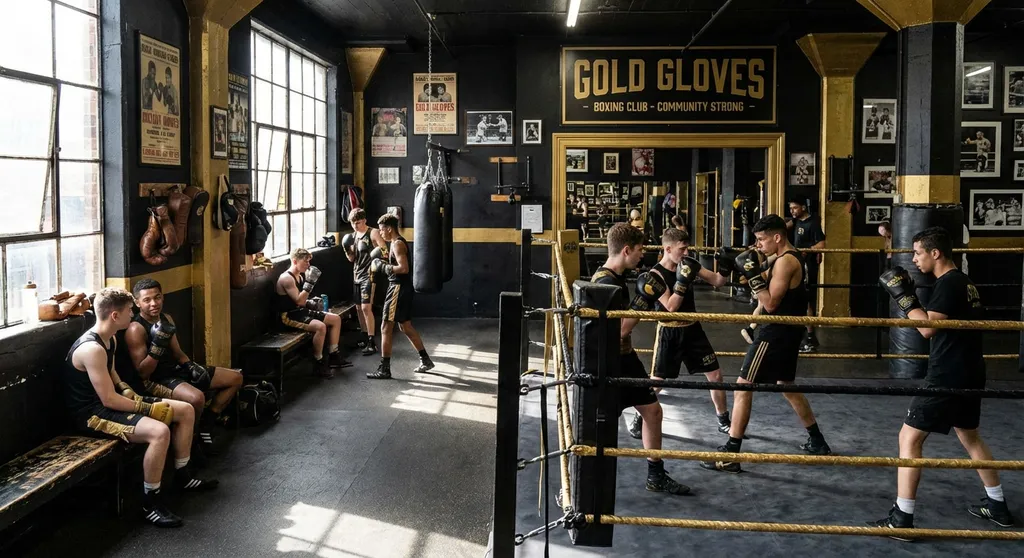
Honour and Glory Boxing Club operates in Kidbrooke, SE3, which is within the Royal Borough of Greenwich. The club was founded with a specific dual purpose: competitive boxing and community mental health support through Honour and Glory Healthy Mind Ltd.
The Junior Recreational class serves young people aged 10-16 at £8.50 per session. The Junior Recreational class takes children from age 7. Both are deliberately priced to be accessible, with no contracts, no joining fee, and no financial barriers beyond the session cost.
The coaches are DBS-checked, ABA-qualified, and experienced in working with young people from a range of backgrounds. The club is not a youth intervention programme in the formal sense, but it provides the same ingredients that the research identifies as effective: structure, mentoring, physical outlet, skill development, and community.
The Honest Position
Boxing clubs do not solve knife crime. Knife crime has structural causes - poverty, inequality, exclusion, trauma - that no sport can address alone. What boxing clubs do is provide a protective factor: a place where a young person can develop in ways that reduce their vulnerability to those structural pressures.
The Moves Different study will tell us more precisely how effective that protection is. Until then, the evidence from Fight for Peace, from parliamentary testimony, and from decades of community boxing experience consistently points in the same direction: young people who train at boxing clubs are less likely to end up in trouble than comparable young people who do not.
H&G Team
Writer at Honour & Glory Boxing Club, a community boxing gym in Kidbrooke, South East London.
Was this page helpful?
Your feedback helps us improve this page
Got questions about what you just read?
ASK OUR AI ASSISTANT ✨MORE LIKE THIS



WANT TO JOIN US?
Book a free trial session and see what we're all about.
Claim a Free Trial