How Boxing Helps Anxious Children
How Boxing Helps Anxious Children
Anxiety in children is more common than most parents want to admit. School pressure, social complexity, and a digital environment that never switches off have created a generation of children who are often unsettled, hypervigilant, and struggling to regulate their own nervous systems. Parents search for the thing that might help. Swimming. Yoga. Therapy. Martial arts.
Boxing is rarely the first suggestion. It probably should be.
This is not a reckless claim. There is a consistent pattern visible to any coach who works with children over many years. Anxious children respond to boxing in ways that surprise their parents and often surprise the children themselves. Understanding why it works requires understanding what anxiety actually does in a child's body and mind.
What Anxiety Does to a Child
Anxiety is a physiological state, not just a mental one. When an anxious child is in a situation that triggers their threat response, their body floods with stress hormones. Their heart rate increases. Their muscles tighten. Their focus narrows. Their thinking becomes reactive rather than deliberate.
The typical response to this in modern childhood is either avoidance or distraction. Keep the child away from the things that trigger anxiety. Give them something pleasant to occupy their mind. Both of these strategies have their place, but neither of them teaches the child to regulate the stress response itself.
Boxing does something different. It teaches the child to function inside a physiologically activated state.
Why Physical Challenge Matters

When a child steps onto the pads with a coach for the first time, they experience a mild version of that stress response. Their heart rate goes up. They feel self-conscious. They do not know what they are doing. Everything is unfamiliar.
And then they do it anyway. They throw the punch. The coach adjusts their position. They try again. And ten minutes later, something has shifted. They are still tired and uncertain, but they have proven to themselves that they can act under discomfort.
This is the fundamental lesson that boxing teaches anxious children, and it is a lesson that generalises far beyond the gym. The capacity to act when you are uncomfortable is the core skill that anxious children are missing. Every session at a boxing gym is, in a sense, a structured practice of exactly that skill.
The Predictability of the Structure
Anxious children tend to struggle in environments that are unpredictable. Open play, unstructured social situations, and activities where the rules keep changing are all significant sources of stress for many children who present with anxiety.
A boxing session is structured, predictable, and bounded. It starts the same way. It follows a consistent sequence. The coach gives clear instructions. The expectations are explicit. For a child whose nervous system is calibrated for threat detection, this kind of structured environment is deeply settling.
At Honour & Glory Boxing Club, 122 Broad Walk, London SE3 8ND, every session follows a consistent format. Warm-up, technical work, pad or bag work, cool-down. Coaches hold BBBofC licences and operate within the England Alliance Boxing framework. The sessions are run to a professional standard, which means the structure is reliable from week to week.
That reliability is not just a convenience. For anxious children, it is part of why the environment starts to feel safe.
The Relationship with the Coach
One of the most consistent things that happens with anxious children in a boxing gym is that they develop a strong relationship with their coach very quickly. Boxing coaching is direct and personal in a way that team sport coaching rarely is. The coach is working with your child on a specific skill in a specific moment. The feedback is immediate and specific.
For anxious children who often feel unseen in group environments, this level of individual attention is significant. They are not one of twenty children running around a field. They are one person, with one coach, working on one thing. That singular focus is both calming and motivating.
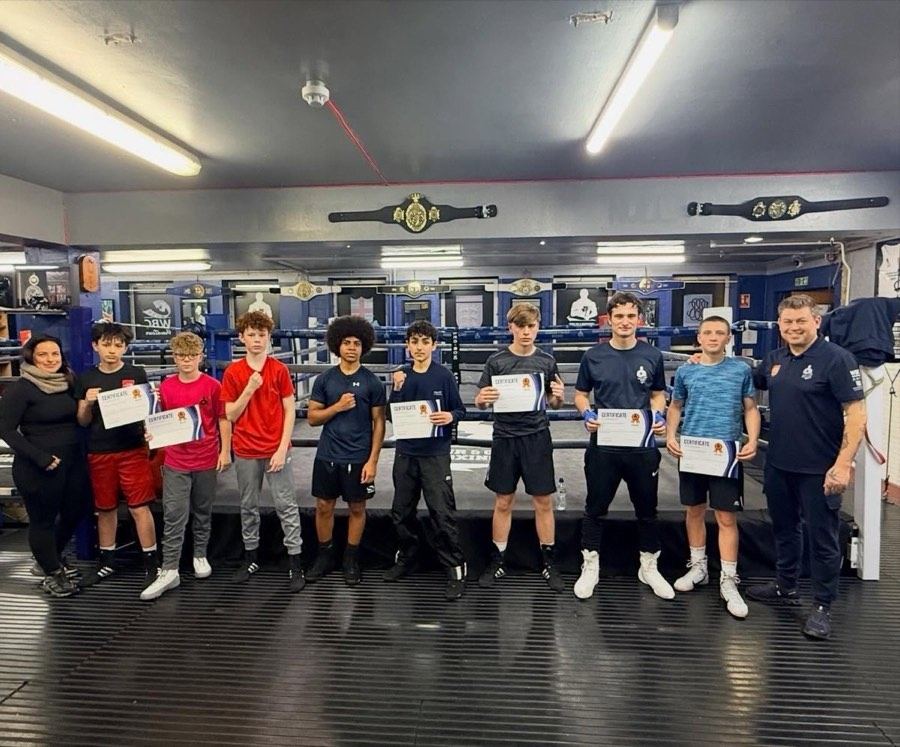
Children in the Juniors group (ages ten to sixteen) at our Kidbrooke gym often describe their coach as one of the people they feel most comfortable being honest with. That trust develops through the honesty of the training environment. Boxing is direct. The coach is direct. And there is something in that directness that anxious children, who are often surrounded by well-meaning but indirect adult communication, find grounding.
Controlled Aggression as a Release Valve
Many anxious children carry a significant amount of unexpressed tension. They internalise. They ruminate. They replay scenarios. The physical outlet of a boxing session gives that tension somewhere to go.
This is not about teaching children to be aggressive. It is about acknowledging that physical energy, when properly channelled, is a healthy part of being human. The boxing bag does not mind being hit. The pads are there for exactly this purpose. And after a session where a child has properly exerted themselves, the physiological state is measurably calmer.
Parents regularly report that their anxious children sleep better on boxing nights. That their mood is better in the evenings after training. That the overthinking that characterises their anxious children seems, temporarily, to quiet down. This is not accidental. It is the natural result of physical exhaustion combined with the focus and structure of a well-run boxing session.
What to Tell Your Child Before the First Session
Anxious children will worry about the first session. They will wonder whether they will be embarrassed, whether they will be hit, whether they will be bad at it.
Tell them this: everyone is bad at it in the first session. That is the point of the first session. No one will hit them without their consent and extensive preparation. The coach has seen hundreds of first sessions. They know exactly what to do with a child who is nervous.
Also tell them that it is okay to feel nervous and do it anyway. That is not a lie. That is the exact lesson boxing is about to teach them.
Infants and Younger Anxious Children
For younger children in the Infants group (ages five to nine), the boxing gym offers a gentle, non-contact environment with all the structural benefits described above but without any of the contact-related concerns. Games, coordination exercises, fun fitness work, and basic technical introduction form the programme at this age.
Many parents of anxious five to nine year olds are surprised by how quickly their child settles into the routine. The structure, the coach attention, and the physical engagement combine in a way that simply works for most children of this temperament.
Classes run Monday through Thursday evenings and Saturday mornings, with free parking available at Honour & Glory Boxing Club in Kidbrooke, SE3.
If your child is anxious and you are looking for something that might genuinely help rather than just pass the time, a free trial session is the lowest-risk way to find out. Book at honourandglory.co.uk/trial and see what a session actually looks like.
If you are searching for boxing classes near you in South East London, we cover what to expect, how to get here, and how to book a free trial.
For younger members, our kids boxing classes cover ages 5 to 16, split between infants (5-9) and recreational juniors (10-16). First session free.
Rate this article
Your feedback helps us write better content
Honour and Glory Boxing Club
Honour and Glory is a boxing club in Kidbrooke, SE3 — 4 minutes from Kidbrooke by car, or 17 minutes by public transport (Bus 335). The club runs classes seven days a week for adults and children from age five, with no joining fee and no contract.
Head coach Anton Pattenden holds a British Boxing Board of Control trainer's licence — the same licence that governs professional boxing in the UK. Classes run from recreational fitness sessions through to amateur competition preparation. The first session is always free.
Address
122 Broad Walk, Kidbrooke, London SE3 8ND
Classes
Adults, Women's, Juniors (10-16), Infants (5-9), Amateur
First session
Free. No booking required. Just turn up at class time.
MORE ABOUT BOXING NEAR KIDBROOKE
Amateur Boxing in Kidbrooke: How to Start
A practical guide to starting amateur boxing in Kidbrooke SE3, with Honour and Glory Boxing Club - from your first session to your first ABA competition.
Back to School Boxing in South East London
September back to school time is perfect for starting boxing in SE London. Honour & Glory in Kidbrooke offers structured junior boxing for ages 5-16.
Best Amateur Boxing in SE London
Serious amateur boxing in South East London. Honour & Glory in Kidbrooke SE3 offers BBBofC-licensed coaching and England Alliance Boxing competition pathways.
READY TO START?
We are just 4 minutes from Kidbrooke. Book a free trial and see what real boxing training looks like.
Claim a Free Trial