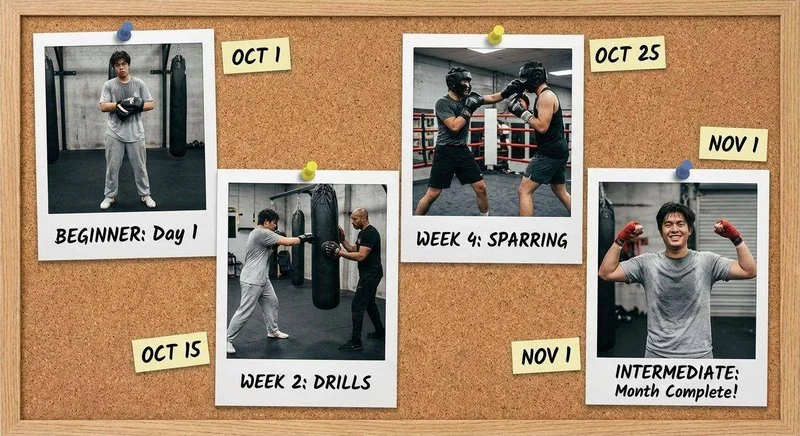
The first month of boxing personal training is the period of fastest change. Your technique, fitness, and understanding of the sport all develop simultaneously. Knowing what to expect makes the process less uncertain and more productive.
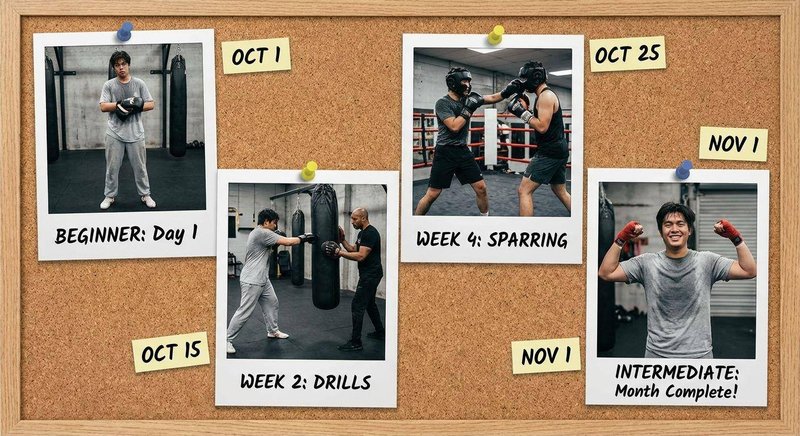
This is what the first 30 days of twice-weekly boxing PT actually looks like.
Week One: Everything is New
The first week is primarily cognitive. You are not just learning physical movements. You are learning a new vocabulary of instruction, a new spatial awareness, and a new set of physical demands.
Your coach will establish your stance in the first session. This takes longer than you expect because stance matters enormously and incorrect habits formed here are difficult to correct later. The coach will check and re-check your foot position, guard height, chin position, and weight distribution throughout the first session.
By the end of week one, most beginners can maintain a reasonable stance and guard, throw a jab with basic mechanics, and throw a cross. The movements are not fluid yet. They are deliberate and slow. But the pattern is in the right place.
Your hands will ache. Your shoulders will be sore. Your calves will be tight from footwork. This is normal and resolves within the first two weeks.
Week Two: Building on the Foundation
Week two introduces hooks and, for many clients, the uppercut. Your coach will work on combining the jab and cross you established in week one with these new punches.
The pad work becomes more engaging in week two. Your coach can now give you three and four-punch combinations that require you to think slightly ahead. The cognitive engagement increases. Sessions start to feel less like a lesson and more like a game you are beginning to understand.
Your conditioning improves noticeably from week one. The same drills that left you breathless in session one feel more manageable. You recover between rounds faster. Your heart rate stays lower during the same intensity of work.
Week Three: Technique Starts to Flow
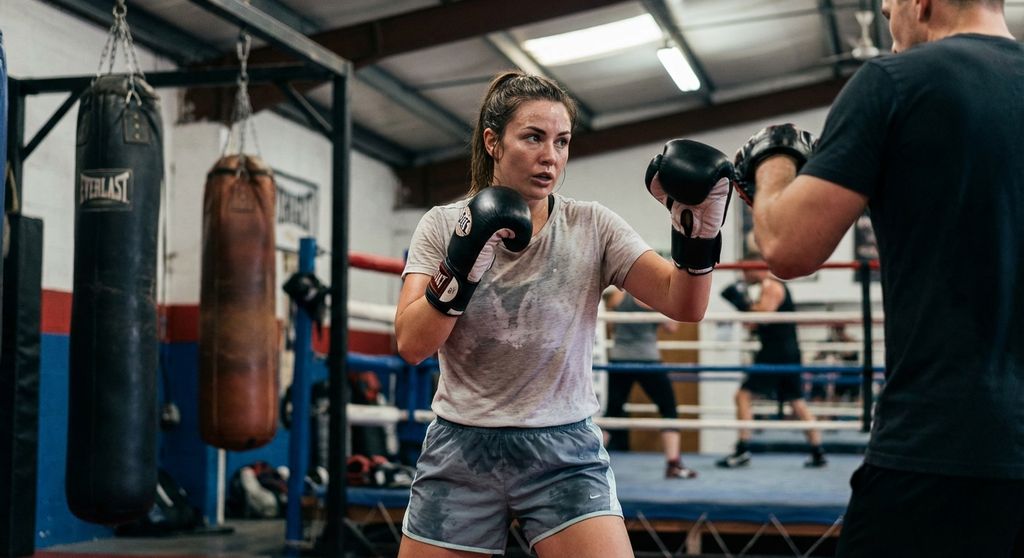
Around week three, something changes that is difficult to describe but immediately recognisable when it happens. The punches start to feel connected rather than sequential. Instead of thinking "jab, then cross, then hook," you start to throw jab-cross-hook as a single flowing movement.
This is a motor learning milestone. The individual patterns have consolidated enough to link together. The cognitive load of each punch decreases, freeing attention for the next one.
Your coach will introduce footwork patterns alongside combinations in week three. Moving while combining, not just standing in place, is the next layer of challenge. This is where boxing starts to feel athletic rather than just technical.
Week Four: Your First Real Rounds
By week four, most beginners are ready for what coaches call "proper rounds." You do three minutes of continuous bag or pad work followed by one minute of rest. No stopping in the middle, no pausing to think, just maintaining output for the full three minutes.
The first time you do a proper round, you will almost certainly be exhausted by the two-minute mark. This is normal. Elite boxers have twelve-round stamina developed over years. You have four weeks.
What the proper round reveals is which technical elements are genuinely established and which are habits you still have to think about. Under fatigue, the deliberate elements disappear first. What remains is your genuine skill.
By the end of week four, the typical client can:
- Maintain guard and stance without constant reminding
- Throw clean jab-cross-hook-uppercut combinations with reasonable mechanics
- Move around the bag or with the coach with basic footwork
- Complete a full round without stopping
This is real progress. It happened in 30 days.
The Physical Changes After One Month
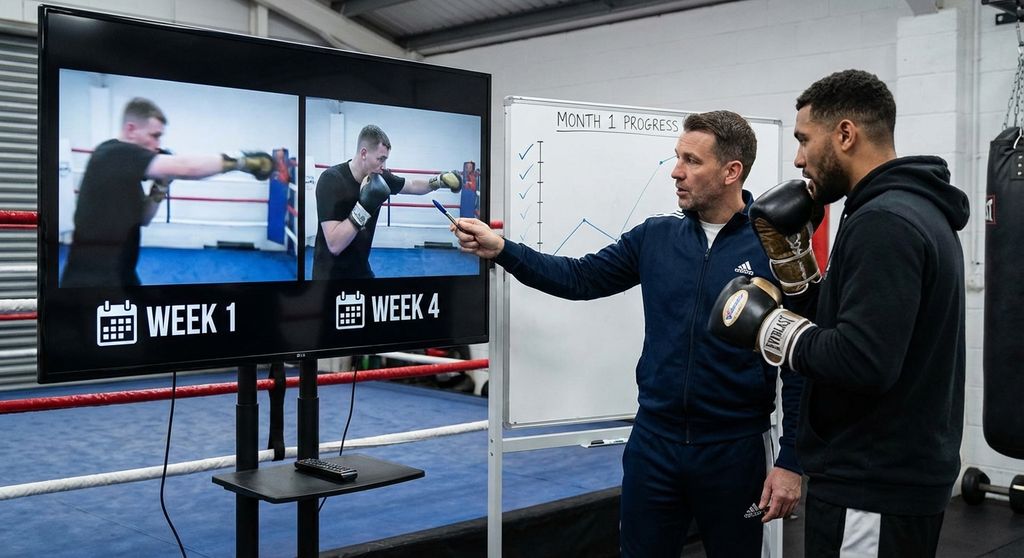
Body composition changes from boxing PT take slightly longer than the skill development to become visible. Most people notice their clothes fitting differently after 6-8 weeks, not 4. But the internal changes after one month are significant.
Research from the British Journal of Sports Medicine found measurable cardiovascular improvements within four weeks of twice-weekly HIIT training. Boxing PT produces equivalent cardiovascular demand. By the end of month one, your resting heart rate will have decreased, your recovery between rounds will have improved, and your capacity to maintain intensity throughout a session will have increased.
Your wrists, hands, and shoulders will have adapted to the training demands. The soreness from week one will be a distant memory. Your grip strength will have increased noticeably.
Month Two: What Changes Next
Month two begins to introduce defensive movement. Head movement, slipping punches, rolling under hooks. The coach also starts to build tactical understanding: not just what to throw, but when and why.
The sessions become more dynamic. Your coach moves during pad rounds, not just standing still holding targets. You have to adjust your footwork, find angles, and respond to movement rather than just throwing at a fixed point.
Month two is when many people become genuinely interested in boxing as a sport rather than just as exercise. The tactical dimension is engaging in a way the early technical instruction was not. You start to understand why professional boxers do what they do.
To experience this progression in paid private coaching, message us about boxing PT. You can also explore the group classes on offer or book a free class trial to see how group training can complement personal training.
Frequently Asked Questions
How quickly do you get fit with boxing personal training?
Most people notice measurable cardiovascular improvement within three to four weeks of twice-weekly boxing PT sessions. Body composition changes typically take six to ten weeks to become visible.
Will I lose weight in the first month?
Weight loss depends on many factors beyond exercise, particularly nutrition. Boxing PT creates a significant calorie deficit over the month, which contributes to fat loss. Combined with appropriate nutrition, one month of regular boxing PT sessions does produce measurable body composition changes for most people.
Is the first month the hardest physically?
As one r/amateur_boxing commenter noted: the structure of a good boxing session should be overwhelmingly boxing-specific. If you are spending more than a few minutes on generic warm-up exercises, the session is not giving you what you are paying for.
See our personal training options for session details and availability.
Yes. The first two weeks are the hardest because your body is adapting to novel demands: hands, wrists, shoulders, and the cardiovascular system. From week three onward, the sessions feel progressively more manageable as the adaptations take hold.
What if I miss sessions in the first month?
Try to maintain at least one session per week in the first month. Two sessions per week is ideal for the reasons discussed above. Missing three or four weeks consecutively in the first month sets you back significantly, as the early motor patterns are not yet consolidated.
Find a Boxing Personal Trainer Near You
H&G covers south and south-east London:
H&G Team
Writer at Honour & Glory Boxing Club, a community boxing gym in Kidbrooke, South East London.
Was this page helpful?
Your feedback helps us improve this page
Got questions about what you just read?
ASK OUR AI ASSISTANT ✨MORE LIKE THIS

WANT TO JOIN US?
Book a free trial session and see what we're all about.
Claim a Free Trial