England Boxing's safeguarding policies and procedures are useful because they set the baseline a junior club should be able to explain clearly. The NSPCC's advice on sports clubs and activities is worth reading because it approaches the issue the way a parent does rather than the way a governing body does.
Parents often know more in ten minutes than they think they do.
A junior boxing club can have the right logo, the right social media, and a busy room full of children, yet still feel slightly off. Another club can be simpler, rougher round the edges, and immediately feel steady, clear and safe.
That instinct matters.
When people ask what makes a good junior boxing club, they usually expect a list of qualifications and safety checks. Those matter, obviously. But parents are not only choosing a timetable. They are choosing a room full of adults, a culture, and a tone that their child will absorb week after week.
So what should a good junior boxing club actually feel like?
It Feels Calm, Not Chaotic
A good junior club has energy, but it does not feel frantic.
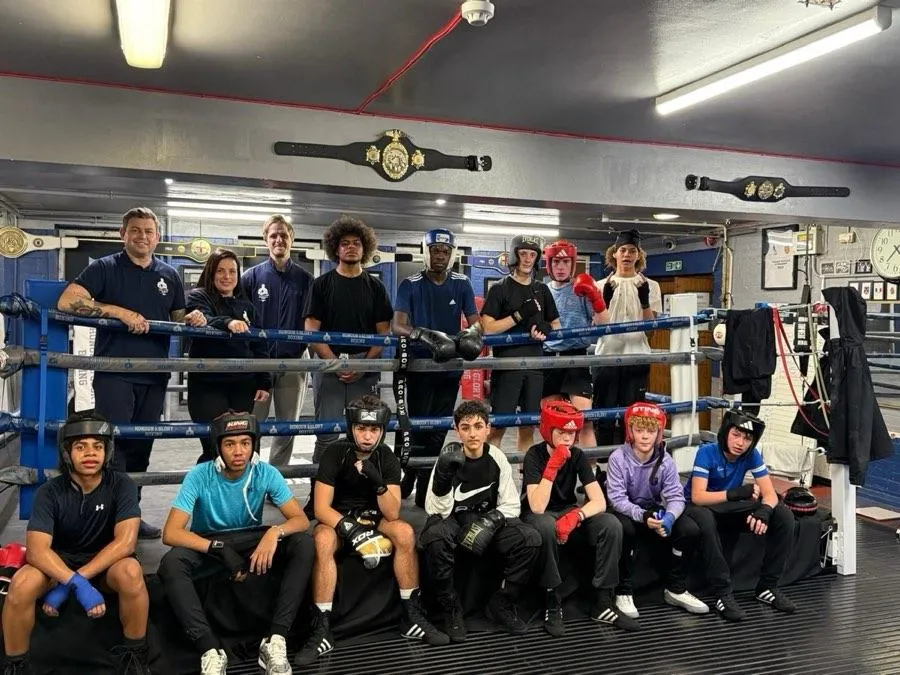
Children are moving, coaches are talking, bags are being hit, and there is noise in the room because boxing is a live sport. But underneath that, there is shape. The adults look in control. The children know where they should be. The session has direction.
That is very different from a room where everyone looks busy but nobody looks properly held.
Parents should be able to see that the gym has a pulse without feeling as though it has no adult centre.
It Feels Structured From the First Minute
A child should not walk into a junior boxing session and feel as though they have been dropped into the middle of random activity.
- children arrive and settle in
- the warm-up starts with purpose
- the coaching focus is clear
- drills build in a logical order
- the session finishes cleanly
Even a nervous child can handle hard work if the structure is clear.
A lot of what parents describe as a child "not taking to boxing" is actually a child not settling into a room that feels disorganised.
It Feels Like the Adults Understand Children, Not Just Boxing
This is one of the biggest differences between a strong junior programme and a weak one.
Some adults know boxing well but do not really know how to teach children. They understand technique, but not development. They know what they want to see, but not how to bring a child towards it.
A good junior coach can do both.
They know when to simplify. They know when to slow the pace. They know when a child needs a firmer correction and when a child needs an early win. They do not confuse volume, ego, or intensity with authority.
Parents can usually hear the difference quite quickly.
It Feels Respectful
Not soft. Respectful.
A good junior boxing club does not talk down to children. It does not humiliate them for getting things wrong. It does not build the room around one loud personality who enjoys being obeyed.
Children are corrected, of course. Boxing is technical and discipline matters. But the correction should feel proportionate and adult.
- clear instructions
- firm boundaries
- direct coaching
- no need for theatre
If the room feels like an adult trying to dominate children for effect, that is not strong coaching. That is weakness dressed up as authority.
It Feels Open to Parents
Parents do not need to coach from the side. Nobody wants a class run by twelve different running commentaries from the wall.
But a good junior club should still feel open rather than guarded.
Parents should be able to ask sensible questions. They should be able to understand who is coaching, what the session is trying to do, and what the expectations are. They should not feel as though ordinary curiosity is an inconvenience.
The right club behaves as though there is nothing to hide, because there is nothing to hide.
It Feels Clear on Safeguarding
Safeguarding should not feel like a special topic that changes the temperature of the conversation.
At a good club, questions about DBS checks, welfare contacts, complaints routes, and supervision are answered plainly. No improvising. No evasion. No offended look because a parent has asked something basic.
Parents are not difficult for caring about this. They are doing their job.
And a club that works with children seriously will sound as though it understands that immediately.
It Feels Like Progress Is Earned, Not Performed
Some clubs are very good at producing the appearance of progress.
Everything looks intense. Children are busy. The room feels dramatic. Parents leave thinking their child has had a serious technical session.
Sometimes that is true. Sometimes it is mostly performance.
- children listen better
- footwork improves
- stance becomes more stable
- combinations become cleaner
- confidence grows without swagger
That kind of progress is quieter, but it is real.

It Feels Like Competition Is a Pathway, Not an Obsession
A healthy junior club respects competition without building the entire atmosphere around it.
Some children will want to box competitively. Some will be suited to it. Some will not. A good club can hold all three of those realities at once.
Parents should feel that competitive boxing is available for the right child at the right time, not pushed as the measure of whether training "counts".
The room should feel like it values discipline, consistency and development first. Competition comes after that, not instead of that.
It Feels Financially Straight
This matters more than people like to admit.
Parents relax more when the commercial side is clear.
- what the sessions cost
- whether there is a contract
- whether there is a joining fee
- how the trial works
- what happens next if your child wants to continue
That clarity creates trust.
Pressure, vagueness and lock-in language create the opposite.
It Feels Emotionally Steady
This is probably the hardest thing to fake and the easiest thing to notice.
A good junior boxing club feels emotionally regulated.
The adults are not volatile. They are not petty. They are not showing off. They are not trying to win little social battles in front of children or parents. They feel like adults who can absorb pressure without making it everyone else's problem.
That matters because sport does not just teach technique. It models adulthood.
Children watch how adults behave when things go wrong, when somebody is difficult, when someone is upset, when someone is behind, and when somebody is talented. They learn from all of it.
The Best Summary Is Usually Very Simple
- your child can work hard without being diminished
- adults behave like adults
- standards are clear
- questions are welcomed
- progress is visible
- the atmosphere feels serious but safe
That is what most parents are really looking for, even if they do not phrase it that way.
If you want a more practical checklist, read our guide on questions to ask a kids boxing club and our piece on red flags in a junior boxing club. If you want to see our own junior set-up, start with our parents page, our kids boxing page, or book a free trial session.
H&G Team
Writer at Honour & Glory Boxing Club, a community boxing gym in Kidbrooke, South East London.
Rate this article
Your feedback helps us write better content
Got questions about what you just read?
ASK OUR AI ASSISTANT ✨MORE LIKE THIS

WANT TO JOIN US?
Book a free trial session and see what we're all about.
Claim a Free Trial