
There is a stubborn idea that is been floating around gyms for decades: boxers should not lift weights. It will make you slow, stiff, muscle-bound. You will lose your snap. Stick to the bag, the pads, and the road.
Some coaches still say it. They are wrong - or at least, they are working from a playbook that is 40 years out of date.
Strength training for boxing, done properly, makes you faster, more powerful, harder to hurt, and less prone to injury. The key phrase there is "done properly." Train like a bodybuilder and yes, you will probably end up slow and heavy. Train like an athlete, and the work can carry over into your boxing.
Here is what that actually looks like.
Why the "no weights" rule existed
Before getting into what to do, it is worth understanding where the myth came from.
Old-school boxing culture came up through an era when strength training basically meant powerlifting or bodybuilding - lots of isolation work, slow tempos, max loads. That kind of training does make some athletes slower. It builds bulk without improving the speed-strength connection that boxing demands.
The coaches who warned against weights were not entirely wrong - they just had not seen the alternative yet. Sports science has moved on. The question is not whether to lift. It is how.
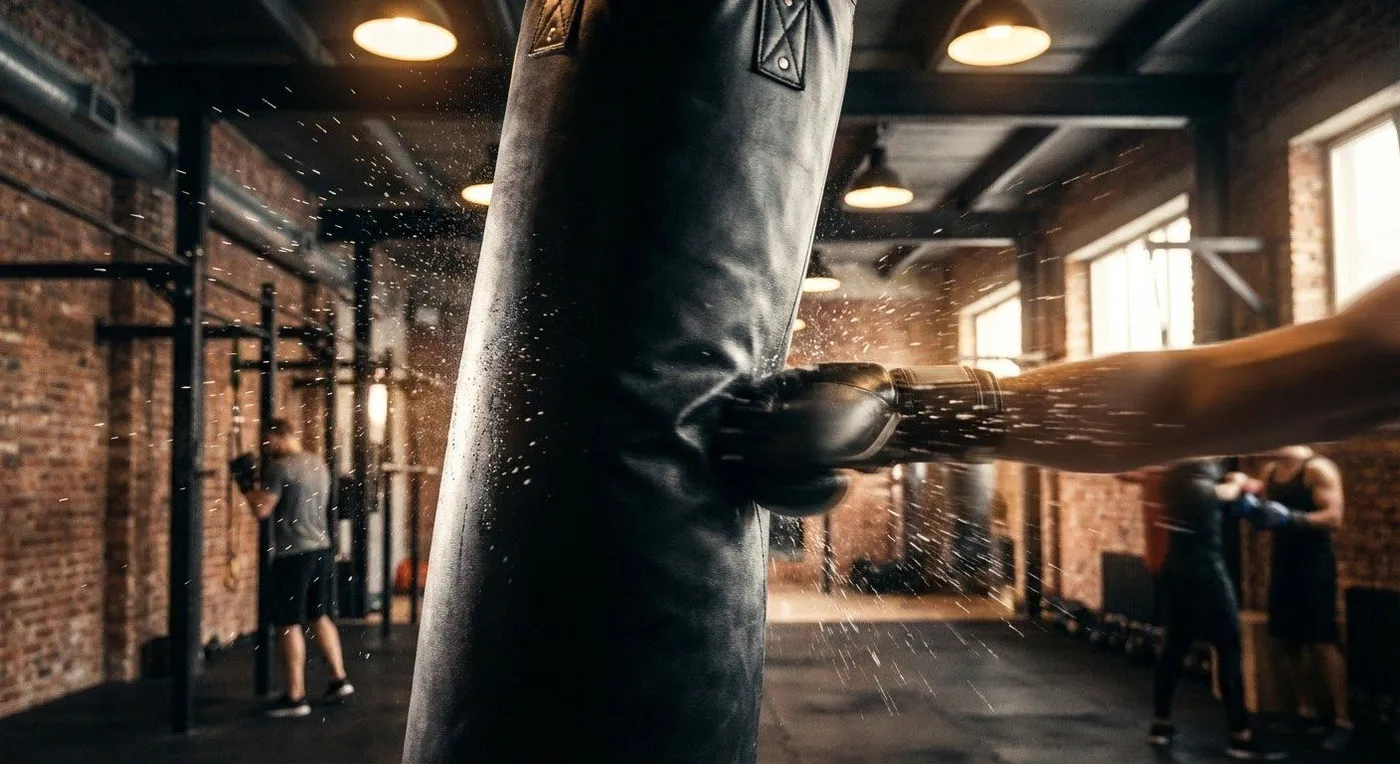
What strength training actually does for boxers
Punching power does not come from your arms. It comes from your legs, hips, and core, transmitted up through the kinetic chain and out through your fist. A boxer with strong legs and a solid core hits harder than one with big arms.
Strength training addresses all of that. Specifically:
Power output goes up. Compound movements like squats and deadlifts train your body to generate force explosively. That force does not stay in the gym - it transfers to your jab, your cross, your hook. A 2024 study in Frontiers in Physiology found that variable resistance training within complex training programmes improved both maximum muscle strength and punch performance in elite amateur boxers. A 2022 review in the Journal of Strength and Conditioning Research examined the specific role strength has on punch impact force in boxing.
Injury risk goes down. Shoulder injuries, wrist problems, lower back strain - these are common in boxing. Strengthening the muscles and tendons around those joints reduces the chance of them giving out under load. Boxers who skip conditioning work tend to be the ones who keep picking up niggles.
You last longer in rounds. Muscular endurance - the ability to maintain output when you are tired - improves with the right kind of resistance work. Anyone who is thrown combinations on the pads for three-minute rounds knows what it feels like when your arms start to go. Strength training delays that.
The exercises worth doing
The goal is athletic strength, not mass. You want your body to move fast, generate power, and recover quickly. These are the movements that contribute to that.
Squats
The squat is probably the single most useful exercise for a boxer. It builds leg drive, which drives punching power. Front squats, goblet squats, or standard back squats - all work. Keep the weight honest: you are training for explosive strength, not a one-rep max. Around 3-4 sets of 5-8 reps at around 70-80% effort tends to be the sweet spot.
Deadlifts
Romanian deadlifts and trap bar deadlifts are both excellent. They train the posterior chain - the hamstrings, glutes, and lower back that underpin everything you do in the ring. Stiff-leg RDLs are particularly good for boxers because they build the hip hinge pattern that generates force in body shots.
Pull-ups and rows
Boxing is mostly a pushing sport - punches go forward. That means the pulling muscles (lats, rear delts, upper back) often get neglected. Neglect them and you end up with shoulder imbalances that cause injury over time. Rows and pull-ups fix that. They also help with retracting your guard quickly between shots.
Press variations
Overhead pressing and bench pressing both have their place, but do not overdo either. The goal is functional shoulder strength, not a big bench. Push-ups, dumbbell presses, and landmine presses all work well. Keep the volume moderate.
Medicine ball work
This is where you bridge the gap between gym strength and boxing-specific power. Med ball rotational throws - standing side-on to a wall and driving the ball through a hip rotation - directly train the same mechanics as throwing hooks and body shots. Med ball slams are excellent for overhead power and core engagement. These are worth including every session.
Core work
A boxer's core is not there to make your abs look good. It is the transmission system between your lower and upper body. If it is weak, power leaks out. If it is strong, it amplifies everything.
The exercises that matter most are not crunches. Planks, hollow body holds, pallof presses, and ab wheel rollouts build the kind of deep stability that transfers to the ring. Russian twists and cable woodchoppers build rotational strength. Dead bugs and bird dogs build the anti-rotation stability that keeps your spine safe when you are absorbing shots.

How to fit it in with boxing training
This is where people go wrong. They add a full strength programme on top of already-full boxing training and then wonder why they are constantly wrecked.
Two sessions per week is enough for most club-level boxers. Three is plenty even for competitive amateurs. The sessions should be shorter than you think - 45-60 minutes, focused, no messing about.
The best timing is after a technical boxing session, not before. You want to be sharp for pad work and sparring. Hit the weights after, when fatiguing muscles matters less.
Programme it in phases:
- Off-season or early prep: higher volume, build a base
- Pre-competition: shift toward explosive, low-rep work; cut volume
- In-season: maintenance mode - keep intensity up, reduce frequency
If you are training at a club like H&G in Kidbrooke and fitting in three or four boxing sessions a week, two well-designed gym sessions will be enough. More than that and recovery starts to suffer.
What to avoid
A few things will slow you down or get you hurt:
Do not train to failure. Strength training for boxing is about quality movement and power development. Grinding out reps when your form has gone builds nothing useful and often causes injury.
Do not ignore flexibility. Lifting tightens things up. If you are not including some mobility work - hip flexors, thoracic spine, shoulders - you will feel it within a few months.
Do not skip sleep. This is where strength gains actually happen. Two gym sessions a week with proper recovery will do more than four sessions on poor sleep.
Do not train like a bodybuilder. Three sets of 12 bicep curls is not strength training for boxing. Stick to compound movements, keep reps relatively low (3-8), and focus on moving the weight fast through the concentric phase.
A simple starter template
If you have never added S&C work to your boxing training, here is a basic two-day split to get started with:
- Squat: 4 x 5
- Romanian deadlift: 3 x 6
- Jump squats: 3 x 5
- Pallof press: 3 x 8 each side
- Ab wheel rollout: 3 x 8
- Pull-ups: 3 x max
- Overhead press: 3 x 6
- Dumbbell row: 3 x 8 each side
- Med ball rotational throw: 3 x 8 each side
- Hollow body hold: 3 x 20-30 seconds
Two days, 45-50 minutes each. Give it eight weeks and the difference in how you move in the ring will be noticeable.
The old arguments against weight training made sense in their time. But the evidence is clear now: boxers who do targeted strength work hit harder, last longer, and stay healthier than those who do not. The trick is doing it right - athletic movements, moderate loads, sensible volume, and enough recovery to absorb the work.
If you want to box better, get stronger. The two are not in conflict.
H&G Team
Writer at Honour & Glory Boxing Club, a community boxing gym in Kidbrooke, South East London.
Was this page helpful?
Your feedback helps us improve this page
Got questions about what you just read?
ASK OUR AI ASSISTANT ✨MORE LIKE THIS

WANT TO JOIN US?
Book a free trial session and see what we're all about.
Claim a Free Trial