Boxing Over 40
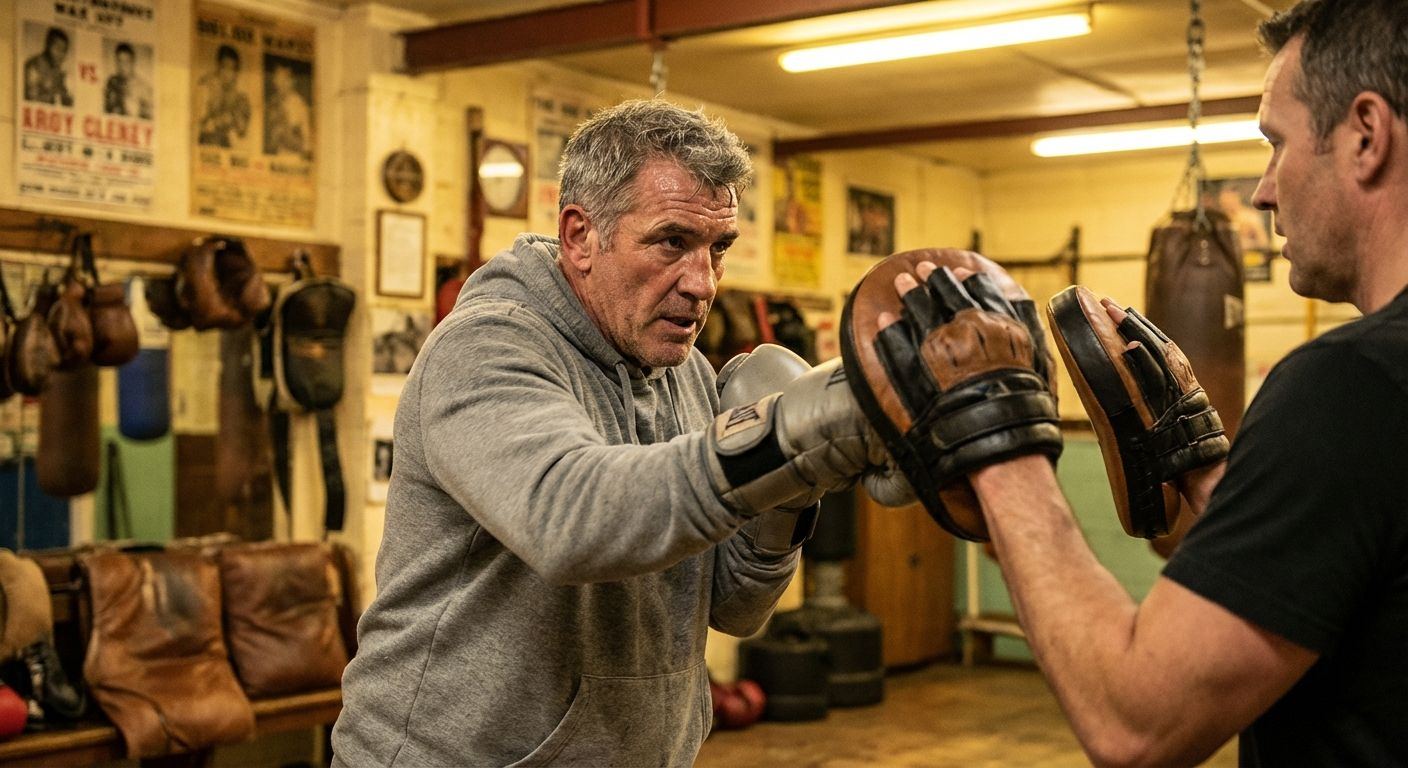
You are not too old to start boxing. At Honour and Glory, some of our most dedicated members walked in for the first time in their forties, fifties, and beyond. In many ways, boxing is better suited to the over-40 body than the alternatives. Here is why, backed by real data and what we see on the gym floor every week.
Why Boxing Is Excellent After 40
Bone Density: The Silent Crisis
After 40, bone density declines at roughly 1% per year. For women post-menopause, that rate can double. The NHS estimates that over 3 million people in the UK have osteoporosis, and half of all women over 50 will fracture a bone because of it.
Weight-bearing, impact-based exercise is one of the most effective interventions. A systematic review on combat sports and bone mass found significant improvements in bone density at all ages among practitioners. The impact of punching a bag sends force through your wrists, arms, and shoulders, stimulating bone maintenance in exactly the areas most vulnerable to age-related loss. Swimming and cycling, by contrast, are non-weight-bearing and do almost nothing for bones.
Coordination, Reflexes, and Your Brain
Cognitive decline after 40 often shows up first as slower reaction time and reduced coordination. Boxing directly trains both. The hand-eye coordination required for pad work, the reaction speed needed for defensive movement, and the complex motor patterns of combination work all keep your nervous system firing.
This is not speculation. Research on boxing-style training for Parkinson's patients, notably the Rock Steady Boxing programme in the US, has demonstrated measurable improvements in gait, balance, and quality of life. If boxing helps people with neurological conditions, imagine what it does for a healthy brain that simply needs stimulation.

Low Impact Compared to Running
Many people over 40 discover that running becomes increasingly brutal on knees, hips, and ankles. The British Journal of Sports Medicine reports that up to 79% of runners experience injury each year, with the rate climbing with age. The repetitive impact of foot-on-road compounds over decades.
Non-sparring boxing does not have this problem. There is no repetitive joint loading. The movements are varied, and the impact goes into bags and pads, not into your joints. At Honour and Glory, we see members in their 50s and 60s training three times a week with zero joint complaints.
Muscle Maintenance (Sarcopenia)
After 40, you lose approximately 3-8% of muscle mass per decade. This accelerates after 60. The medical term is sarcopenia, and it is one of the primary drivers of frailty in older adults. Boxing counteracts this by building and maintaining lean muscle across the entire body. The explosive nature of punching, combined with conditioning work (skipping, press-ups, core drills), provides the resistance stimulus needed to preserve muscle mass.
As one r/amateur_boxing member in their forties put it: "I am fitter now at 43 than I was at 25. Boxing did that."
What Training Actually Looks Like at 40+
You do not need to train like a 20-year-old preparing for a fight. Boxing at 40+ is about working at your level, with a coach who adjusts intensity to suit your body. At Honour and Glory, a typical recreational adults session includes:
Warm-up (15 minutes)
Extended and thorough. Your body needs more warm-up time than it used to, and good coaches know this. Skipping, shadow boxing, mobility work.
Technical work (20 minutes)
Pad rounds with the coach, bag work, partner drills. Focus on technique rather than power. Good technique is more efficient and far less injury-prone.
Conditioning (15 minutes)
Body-weight circuits, core work, skipping. Scaled to your fitness level. Nobody is expected to keep up with anyone else.
Cool-down (10 minutes)
Stretching and recovery. Increasingly important as you get older.
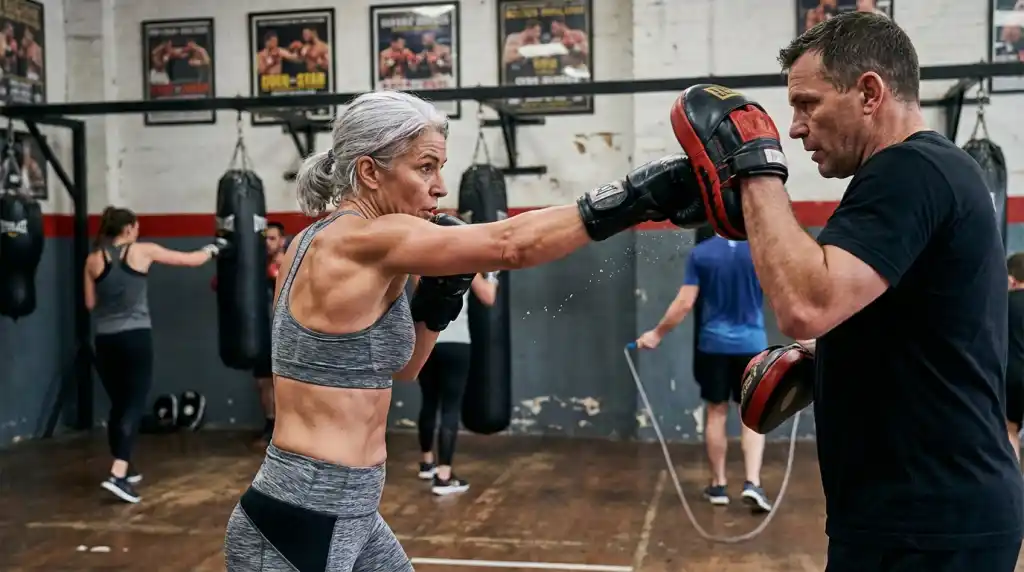
Sparring is always optional. Many of our over-40 members choose not to spar, and that is perfectly fine. You still get 95% of the physical and mental benefits from non-contact training. The remaining 5% is the adrenaline of competition, which you can get from pad work and bag rounds if you push yourself.
A sensible frequency is three sessions per week with rest days between. Recovery takes longer after 40, and respecting that is not weakness. It is intelligence.
Calorie Burn and Fitness at 40+
Calories burned per hour (70 kg person, age 40-55)
Source: Coach Magazine (Forza study)
A person over 40 burns approximately the same calories per session as a younger person of the same weight. As metabolism naturally slows with age (roughly 1-2% per decade after 30), having an effective calorie-burning activity becomes more valuable, not less. Boxing is one of the most efficient options available, and unlike running, it does not wreck your knees to achieve it.
The Mental Benefits After 40
Learning a new skill after 40 is one of the best things you can do for cognitive health. The neuroplasticity research is clear: novel, complex motor tasks create new neural pathways and strengthen existing ones. Boxing requires you to think, react, and coordinate in ways that are genuinely challenging for your brain. That challenge is the point.
Then there is the stress relief. Midlife is often the most stressful period: career pressure, family responsibilities, financial concerns, health worries. Boxing provides a physical outlet for all of it. You cannot think about a difficult meeting at work when a coach is calling a jab-cross-hook-slip combination and you need to execute it in the next half second.
The confidence piece matters too. There is something about knowing you can throw a decent one-two that changes how you carry yourself. Not aggression. Quiet assurance. Many of our members over 40 say this is the benefit they expected least and value most.
Cost in London
Many over-40 fitness options in London are expensive. Personal training runs £50-£80 per session. Boutique fitness studios (Barry's, 1Rebel, KOBOX) charge £20-£25 per class. Even a decent gym membership costs £50-£95 per month, and that is before you factor in the motivation problem of going alone.
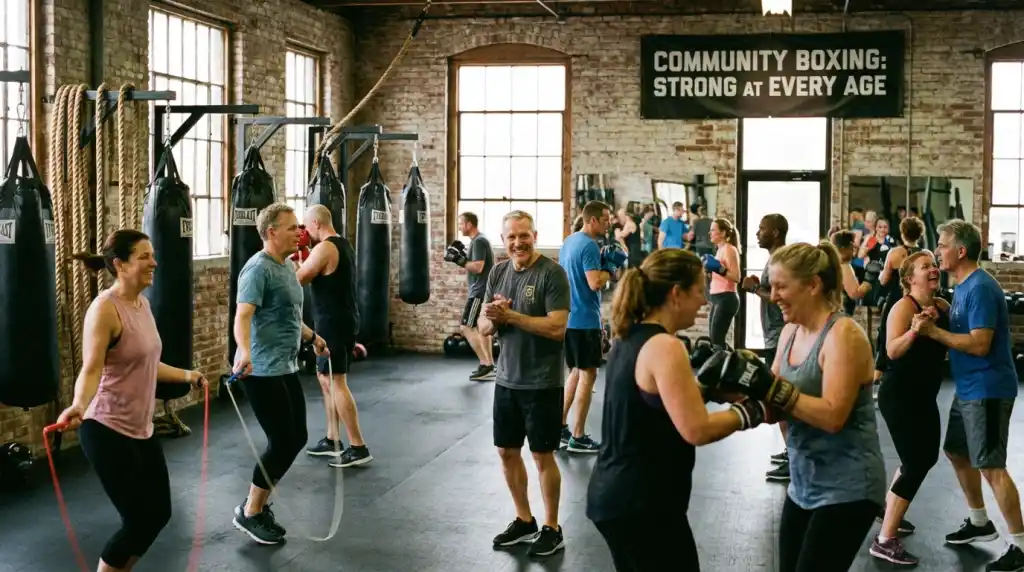
Community boxing clubs offer exceptional value. At Honour and Glory, sessions cost £5-£10 each. No contracts, no joining fees, no minimum commitment. You can train three times a week for roughly £30-£40 a month. For coached, structured group training with real skill development, that is hard to beat anywhere in London.
We are based in Kidbrooke, easily reachable from Blackheath, Greenwich, Eltham, and Charlton. All ages from 5 to 65+ train under the same roof.
Common Concerns (Addressed Honestly)
"Will I get hit?"
Only if you choose to spar, and sparring is never compulsory. Most of our over-40 members do bag work, pad work, conditioning, and technical drills. That is a complete workout without any contact at all.
"I am not fit enough to start."
Nobody is fit enough on day one. Boxing builds fitness. Your first session will be hard. Your tenth will feel manageable. Your fiftieth will feel natural. Every single person who walks through our door starts at square one.
"I have a dodgy knee / bad back / old injury."
Tell your coach. Boxing is highly adaptable. Knee issue? We modify footwork drills. Back problem? We adjust conditioning exercises. The variety of boxing training means there is always an alternative. Unlike running, which requires your knees to cooperate every single step, boxing can work around limitations.
"Will I be the oldest person there?"
Probably not. And even if you are, nobody cares. A boxing gym is one of the most egalitarian environments you will find. The 22-year-old and the 55-year-old both struggle through the same conditioning round. Respect is earned by showing up, not by being young.
The Verdict
Boxing is not just suitable for people over 40. In many ways, it is ideal. It addresses the specific challenges of ageing: bone density loss, muscle decline, coordination slowdown, metabolic reduction. It does this while being lower impact than running, more engaging than gym machines, and cheaper than almost every alternative.
The skill element keeps your brain active. The community keeps you motivated. The confidence you build does not diminish with age. And you will look and feel noticeably better within eight weeks. Want to see for yourself? Book a free session and find out.
See also: How Fit Do You Need to Be to Start Boxing? | Boxing for Mental Health | Boxing Body Transformation
Rate this article
Your feedback helps us write better content
The best way to decide? Come and try it.
Your first session is free. No contract, no commitment.
Book Your Free Boxing Session
Your first session is free. No contract, no joining fee, no catches.
📍 122 Broad Walk, SE3 8ND · Pay as you go from £5