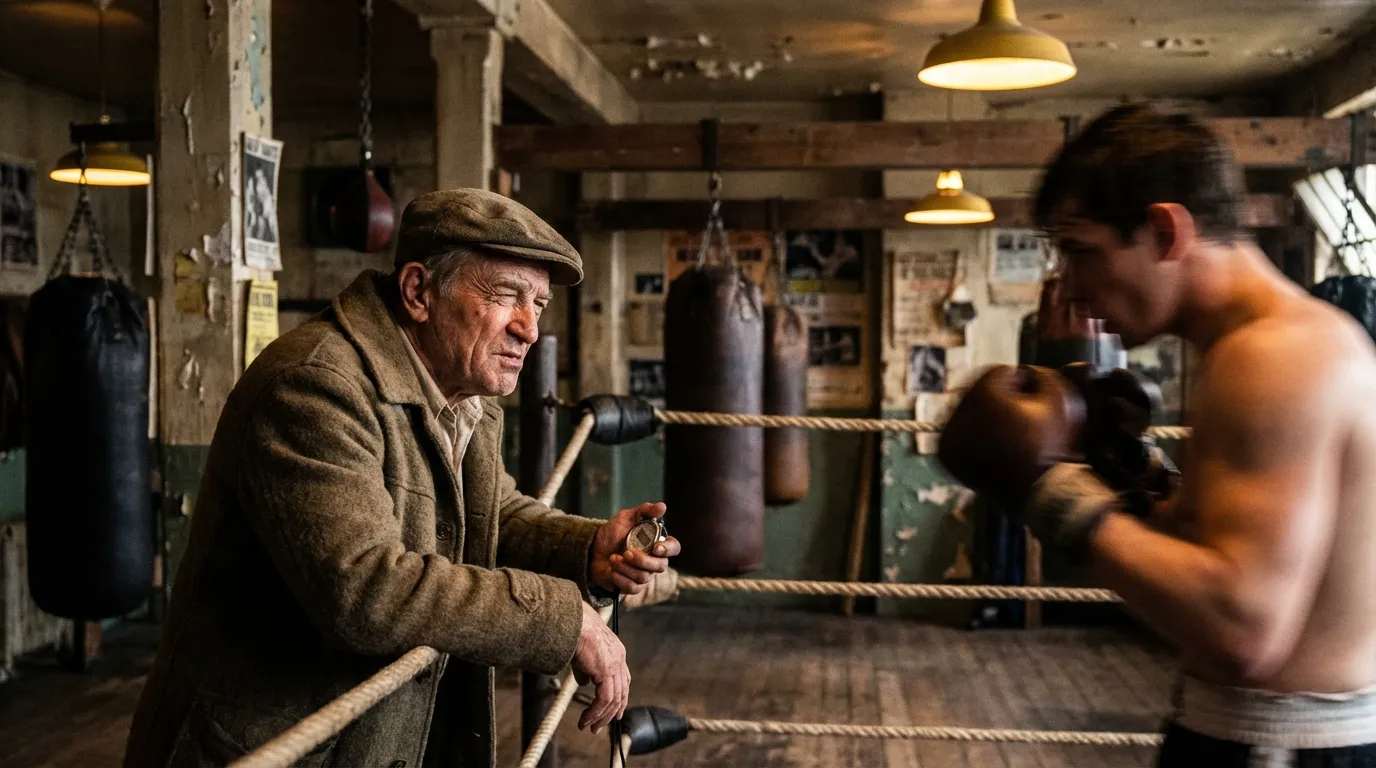
There is a persistent myth in boxing that you need to have been a fighter to be a great coach. That somehow, unless you have taken punches yourself, you cannot possibly understand how to teach someone else to throw them.
The history of the sport dismantles this idea completely.
Some of the greatest trainers in boxing history never fought professionally. A few barely fought at all. And yet they produced champions, developed entirely new fighting styles, and shaped the direction of the sport for decades.
Here are their stories.
Angelo Dundee - The Man in Ali's Corner
Angelo Dundee trained Muhammad Ali for virtually his entire professional career, from his second fight in 1960 through to his final bout in 1981. He also trained Sugar Ray Leonard, George Foreman, Carmen Basilio, and fifteen other world champions.
Dundee never had a professional fight. He boxed briefly in the military during World War II, but his career was entirely as a cornerman and trainer.
What made Dundee exceptional was his ability to read a fight in real time and communicate adjustments between rounds in a way that fighters could actually use. He was calm when his fighters were rattled, tactical when they were emotional, and precise when the margin between winning and losing came down to one small adjustment.
His partnership with Ali is one of the most celebrated relationships in sport. But Dundee was not just Ali's coach. He was the man 15 world champions trusted with their careers. His Hall of Fame induction in 1994 was a recognition of coaching genius, not fighting ability.
Cus D'Amato - The Philosopher Who Changed Boxing
Cus D'Amato developed the "peek-a-boo" style of boxing. He trained Floyd Patterson to become the youngest heavyweight champion in history. He trained Jose Torres to a world title. And he discovered Mike Tyson, a troubled teenager from Brownsville, and turned him into the most feared fighter on the planet.
D'Amato's own fighting experience was negligible. Some sources credit him with one amateur fight. He never fought professionally.
What D'Amato had instead was an extraordinary understanding of the psychology and mechanics of combat. He studied how fear works. He believed that a fighter's primary job was "not to hit, but not to get hit." He built an entire fighting system around this principle, with constant head movement, hands held high, and explosive counterattacks.
D'Amato was part trainer, part psychologist, part father figure. He legally adopted Tyson. He did not just teach boxing. He built boxers from the inside out, starting with their minds.
He died in 1985, a year before Tyson won his first world title. But every technique Tyson used to destroy opponents in those early years came directly from D'Amato's system.
Ray Arcel - Six Decades Without Throwing a Punch
Ray Arcel's career spanned from the 1920s to the 1980s. He worked with Roberto Duran, Larry Holmes, Benny Leonard, and Ezzard Charles, among dozens of others. He trained or seconded 22 world champions over the course of his career.
Arcel never boxed. He grew up around gyms in New York and began learning the craft of training as a teenager. By his twenties, he was already working corners at world championship level.
His longevity was remarkable. He was forcibly retired in the 1950s after refusing to cooperate with the mob (he was attacked with a lead pipe outside Madison Square Garden), but returned to training in the 1970s. His final major fighter was Roberto Duran, whom he trained alongside Freddie Brown for the legendary "No Mas" fight against Sugar Ray Leonard in 1980.
Arcel proved that coaching is a craft that deepens with experience. His understanding of boxing was built over sixty years of watching, analysing, and teaching. No personal fighting career could replicate that depth of observation.
Enzo Calzaghe - The Self-Taught Father
Enzo Calzaghe moved to Wales from Sardinia and taught himself to coach boxing with no professional fighting background whatsoever. He then trained his son Joe to an undefeated professional record of 46-0, including world titles in two weight divisions.
He also trained Enzo Maccarinelli and Gavin Rees to world titles.
Calzaghe was awarded an MBE, named BBC Sports Coach of the Year, and won Ring Magazine Trainer of the Year in 2007. All from a man who learned the sport by studying it, not by fighting in it.
His story is arguably the most inspiring on this list for any aspiring coach. Calzaghe proved that passion, intelligence, and dedication can produce world-class results regardless of personal experience in the ring.
Gil Clancy - The Strategist
Gil Clancy trained Emile Griffith throughout his entire 20-year professional career, guiding him to welterweight and middleweight world championships. He later worked with George Foreman and Oscar De La Hoya.
Clancy boxed as an amateur during World War II but never turned professional. His approach to training was cerebral. He was a strategist who could analyse an opponent's style and build a game plan to neutralise it. He was also a respected commentator, bringing his analytical mind to television coverage of the sport.
His Hall of Fame induction recognised something that great trainers demonstrate repeatedly: that understanding boxing as a system, as a set of problems to be solved, is more valuable than personal fighting experience.
Amilcar Brusa - 14 World Champions
Amilcar Brusa began training boxers in Argentina in 1950 and went on to produce 14 world champions. His most famous fighter was Carlos Monzon, the legendary middleweight who made 14 successful title defences between 1970 and 1977.
Brusa took Monzon under his wing in 1963 and built him into one of the greatest middleweights in history. He was described as Monzon's "trainer, mentor, and father figure."
Brusa was inducted into the International Boxing Hall of Fame in 2007, named Trainer of the Year in 1989, and is widely considered the greatest boxing trainer South America has ever produced. None of this required him to have been a professional fighter.
Terry Edwards - The Olympic Architect
Terry Edwards started boxing at school and was, by his own admission, "never any great shakes" as a fighter. He spent his entire adult life coaching instead.
And what a coaching career it was. As Great Britain's Head Coach, Edwards guided Team GB through three Olympic Games, five World Championships, and five European Championships. Under his watch, British boxing produced: (source).
- Audley Harrison (Olympic gold, Sydney 2000) (source).
- Amir Khan (Olympic silver, Athens 2004) (source)).
- James DeGale (Olympic gold, Beijing 2008) (source).
- David Price and Tony Jeffries (Olympic bronze, Beijing 2008) (source).
- Frankie Gavin (World Champion)
- Luke Campbell (European Champion)
Edwards was awarded an MBE in 2008 and voted UK Sports Coach of the Year in 2004. He proved that at the highest level of amateur boxing, coaching ability is what produces champions, not personal competitive history.
Emanuel Steward - The Amateur Who Became a Legend
Emanuel Steward deserves an honourable mention. He had a successful amateur career of roughly 100 fights and won a national Golden Gloves title, but he never boxed professionally. He went straight from amateur fighter to trainer, building the Kronk Gym in Detroit into the most famous boxing gym in America.
Steward trained Tommy Hearns, Wladimir Klitschko, Lennox Lewis, and dozens of other champions. His amateur background was real, but his greatness came from coaching, not fighting.
What This Means for Coaching
The pattern across all these trainers is consistent. Great boxing coaching requires:
- Deep understanding of mechanics and strategy
- The ability to communicate under pressure
- Emotional intelligence and psychological insight
- Thousands of hours of observation and analysis
- Genuine care for the fighters they train
None of these qualities require personal fighting experience.
This is not to say that fighter-coaches are inferior. Freddie Roach, Floyd Mayweather Sr., and many other excellent trainers had professional careers. But the idea that you must have fought to coach is demonstrably false.
The best trainers in boxing history prove that understanding the game matters more than having played it. Strategy, psychology, and the ability to bring the best out of another human being are skills that can be developed through study, mentorship, and dedication.
It is one of the things that makes boxing coaching such a rewarding discipline. The sport welcomes anyone with the intelligence and commitment to learn it deeply, whether or not they have ever stepped into a ring themselves.
H&G Team
Writer at Honour & Glory Boxing Club, a community boxing gym in Kidbrooke, South East London.
KEEP READING
The Greatest Boxing Knockouts in History
The greatest knockouts in boxing history were not lucky punches. Each one was the result of specific technical and tactical conditions. Here is what made them happen.
The Greatest Upsets in British Boxing History
British boxing has produced some of the most dramatic upsets in the sport's history. Each one tells a story about preparation, complacency, and what happens when everyone is wrong.
Tyson Fury Outpoints Arslanbek Makhmudov
Tyson Fury beat Arslanbek Makhmudov by unanimous decision on Netflix, but the bigger story was how he managed the rounds, what he still does well, and what this does not prove yet.
Was this page helpful?
It takes one tap, and it genuinely helps.
Choose your next step
Turn this article into the right action
Some readers are ready to book. Some need the class route first. Pick the route that matches what you actually want.