
You have signed up for a white collar boxing event. The confirmation email arrived, you have told your friends, and now reality hits: you need to actually prepare to step into a boxing ring.
Whether it is Ultra White Collar Boxing, Peacock WCB, White Collar Fight Club, or another UK show, the preparation is roughly the same. You have 8-12 weeks to go from complete beginner to someone ready to compete in front of hundreds of people.
This guide covers what you need to know, written by coaches who've trained fighters for UK white collar shows and competed at amateur level.
Understanding White Collar Boxing
White collar boxing brings boxing to complete beginners and office workers. It started at Gleason's Gym in New York and exploded in the UK over the past 15 years.
The format: charities and boxing gyms run 8-12 week training camps for absolute novices, then match them with similar opponents for black-tie boxing events. You raise money for charity, get very fit, and do something most people will not.
The UK White Collar Boxing Scene
Several major promoters run shows across the UK:
Ultra White Collar Boxing (UWCB) - The largest, partnered with Cancer Research UK. Free training camps nationwide with the catch that you sell tickets and raise donations. Events at major venues like York Hall and regional arenas.
Peacock White Collar Boxing - Based at Peacock Gym in London, runs inter-club shows at York Hall. More focused on ongoing white collar boxing classes rather than one-off events.
White Collar Fight Club - Partners with CALM charity, uses Gymbox locations across London. Eight-week camps similar to UWCB model.
Regional shows - FIT Club in Newcastle, Future of Boxing in Kingston, and various gyms running local white collar events.
What Makes WCB Different from Amateur Boxing
Shorter preparation - 8-12 weeks versus years of training for amateur boxers.
Matched by size and experience - Organisers match opponents by weight, height, and experience level, not boxing skill.
Charity fundraising - Most shows require ticket sales and charity donations as part of entry.
Modified rounds - Usually 3 rounds of 2 minutes (versus 3 rounds of 3 minutes in amateur boxing).
More protection - 16-ounce gloves instead of 10-ounce, mandatory headguards, and referees authorised to stop fights early for safety.
Who Does White Collar Boxing?
Over 70% of white collar boxers have never thrown a punch before signing up. They are office workers, teachers, accountants, managers, and professionals who want a physical challenge and to raise money for charity.
Some want to test themselves physically and mentally. Others want a fitness goal with real accountability (you cannot skip leg day when you are fighting in 8 weeks). Many do it once, achieve their goal, and move on with life.
Your 8-12 Week Training Timeline
Weeks 1-2: Fundamentals

- Orthodox or southpaw stance (based on which foot feels natural forward)
- Jab and cross (the 1-2 combination every boxer learns first)
- Basic footwork (how to move forward, backward, and laterally without crossing your feet)
- Fundamental defence (slip, duck, block with gloves)
- Conditioning baseline (skipping, running, circuit training)
Goal: Move like a boxer, throw basic punches with proper form, build a cardiovascular base.
Training: 3 sessions per week minimum - 2 boxing technique, 1 conditioning.
What it feels like: Awkward. Your brain knows what to do but your body will not listen. Your shoulders will burn after 3 minutes on the pads. Normal.
Weeks 3-5: Building Your Arsenal
- Hooks and uppercuts (completing your punch vocabulary)
- Combination punching (stringing 3-4 punches together)
- Head movement and defensive reflexes (getting out of the way before blocking)
- Ring craft basics (using angles, controlling distance)
- Controlled technical sparring introduction (week 5 for most fighters)
Goal: Put combinations together smoothly, defend incoming shots, start applying skills under light pressure.
Training: 4-5 sessions per week ideal - 3 boxing, 2 conditioning.
What it feels like: Things start clicking. You can throw a jab-cross-hook without thinking about it. Pad work gets fun. You are simultaneously excited and terrified about sparring.
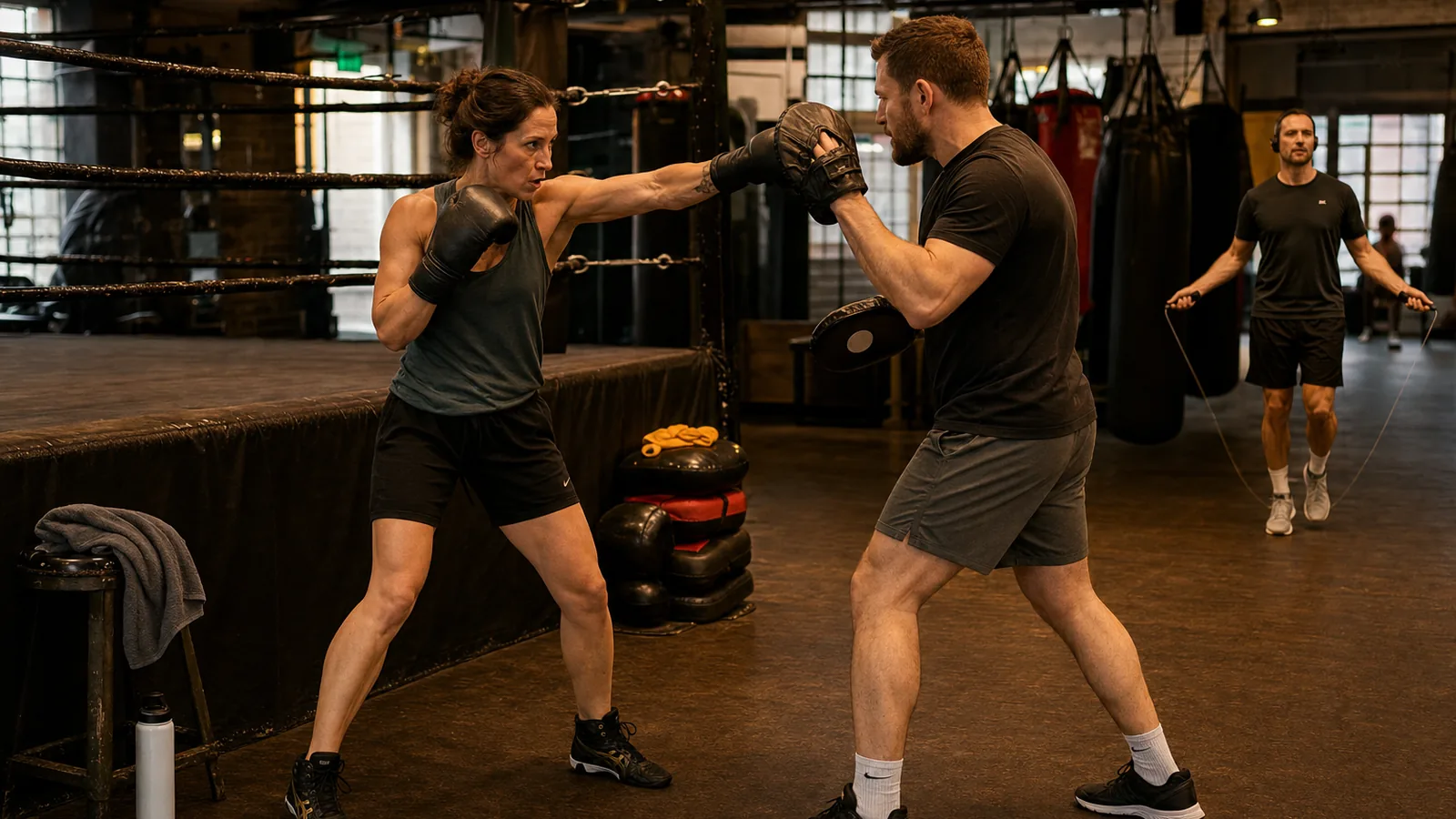
Weeks 6-8: Sparring and Strategy
- Regular controlled sparring (2 times per week)
- How to stay calm when someone's actually trying to hit you
- Ring generalship (using space, controlling the pace, not just reacting)
- Working under fatigue (technique when you are exhausted)
- Mental preparation begins (visualisation, managing nerves)
Goal: Comfortable in the ring, able to execute your skills under pressure, understanding your fight style.
Key milestone: Many shows have you meet and spar your opponent during weeks 6-7. This is good - it removes the fear of the unknown.
What it feels like: Sparring is scary the first time, then addictive. You realise getting hit is not as bad as you thought. You start seeing punches coming and actually slipping them. You feel like an actual boxer.
Weeks 9-12: Fight Prep (if you have 12 weeks)
- Fine-tune technique based on sparring feedback
- Strong conditioning for the event
- Weight management if needed (covered below)
- Taper week before fight (reduce training volume, maintain intensity)
- Mental visualisation and simulated fight scenarios
- Logistics (what to bring, who is in your corner, etc.)
Goal: Peak physically and mentally on fight night.
What it feels like: Nervous energy. Excitement. Checking the calendar constantly. Dreaming about the fight. This is normal.
Absolute Minimum Training
Cannot train 4-5 times per week?
- 2 boxing sessions (pad work, bag work, sparring)
- 1 dedicated conditioning session (running, circuits)
- Plus shadow boxing and skipping at home (10-15 minutes daily)
Warning: If you can only do 2 sessions per week, you are not ready. Wait for a show when you can commit proper time.
What to Expect in Training
Pad Work
You punch, the coach holds pads and calls combinations. This develops power, accuracy, timing, and reflexes.
For many beginners, pad work is the most fun part of training. You feel like a professional boxer. The sound of gloves hitting pads is addictive.
Progression: First week you will do 30-second rounds. By week 8, you will do 3-minute rounds with 30-second breaks (simulating your fight).
Bag Work
Heavy bag - Develops power and teaches you to punch through a target, not at it.
Speed bag - Rhythm and shoulder endurance. Looks cool when you can do it properly. Takes weeks to get the timing right.
Double-end bag - The small one that bounces back. Develops accuracy, timing, and teaches you to keep your hands up (it hits back).
Sparring
This is where you learn to box, not just throw punches.
When it starts: Most camps introduce sparring in weeks 5-6, starting very light and controlled.
Protective equipment: 16-ounce gloves (bigger than fight gloves for more padding), headguard, mouthguard, groin guard.
How it works: Your coach matches you with similar-sized, similar-experience partners. First sessions are "touch sparring" - 30% power, focusing on applying technique. Intensity increases gradually.
Your opponent: Most shows require you to spar your actual opponent before fight night. This is good - you get comfortable with each other, the fear of the unknown disappears, and you both fight better on the night.
The reality: Everyone is nervous before their first sparring session. That first punch you take is a revelation - it is not that bad. Your brain exaggerates the fear. Once you get through it, most fighters want to spar every session.

Conditioning
This matters more than technique for white collar boxing.
Running: 3-5 kilometres, 2-3 times per week. Boxing is 90% cardiovascular. If you gas out in round 2, your beautiful technique is worthless.
Skipping: 10-20 minutes per session. Develops footwork, rhythm, shoulder endurance, and cardio simultaneously.
Circuit training: Push-ups, burpees, sit-ups, squats, mountain climbers. Usually done at the end of boxing sessions when you are already tired - this simulates fighting while exhausted.
Shadow boxing: Practising combinations without equipment. Coaches often make you shadow box between exercises when you are exhausted, because that is when your technique falls apart and needs the most work.
Why Conditioning Matters More Than Technique
You can have beautiful punching form, but if you are completely gassed 90 seconds into round 1, you cannot use it.
Most white collar fights are won by the fitter fighter, not the more technical one.
Adrenaline on fight night burns energy at an insane rate. You need a deep cardiovascular tank. The fighters still throwing crisp punches in round 3 trained their conditioning hard.
Common Mistakes White Collar Fighters Make

1. Starting Too Late
"I will be fine with 6 weeks" - No, you will not.
Eight weeks is the absolute minimum to prepare properly. Ten to twelve weeks is ideal.
- Build cardiovascular base (cannot rush this)
- Learn defensive skills (not just punching)
- Spar enough times to get comfortable
- Let your body adapt to the training load
Fix: When you see a show you want to do, sign up immediately. Do not wait until "closer to the date."
2. Neglecting Cardio Outside the Gym
Showing up to boxing sessions but not running or doing conditioning on off days.
The boxing sessions teach you technique and tactics. The running builds the engine that makes everything work.
Fix: Run 2-3 times per week, 3-5km minimum. Not negotiable. Every white collar fighter who gasses out says the same thing afterwards: "I should have run more."
3. Over-Training the Week Before
Trying to cram in extra sessions the final week. Going hard in last sparring sessions. Doing one more long run 3 days before the fight.
Result: You show up beaten up, exhausted, and flat on fight night.
Fix: Taper properly. Reduce training volume by 40-50% the week before. Maintain intensity (still train hard when you do train) but cut the frequency. Your body needs to recover and peak (source).
4. Not Learning defence
Spending all your time punching bags and pads, neglecting head movement, blocking, and parrying.
On fight night, your opponent will throw punches back. If you only know offence, you will take unnecessary punishment.
Fix: Insist your coach works defence into every pad session. Practise slipping and moving your head, not just blocking. Make sparring your priority - that is where defence is learned.
5. Skipping Sparring
Avoiding sparring because it is uncomfortable or scary.
Then fight night arrives and the first real punch you take is in front of 500 people. That is not a good time to discover you freeze up when hit.
Fix: Embrace sparring from day one. Start light, build gradually. It is the most important part of preparation. Every session makes the next one less scary.
6. Trying to Lose Too Much Weight
Attempting to drop 10-15 pounds in the last 2 weeks to fight smaller opponents.
This weakens you massively. You will be drained, irritable, have no energy, and perform terribly. Plus it is dangerous - dehydration affects your brain's ability to handle impact.
Fix: Fight at your natural weight with full energy. Better to be the smaller fighter at full strength than the bigger fighter running on empty.
Weight Management for White Collar Boxing
Weight Classes Vary by Show
Most events: 5-7 pound weight brackets.
Some shows: 10-pound brackets.
Weigh-in: Usually 1-2 days before the fight. You are matched with someone in your weight bracket at that weigh-in.
Should You Cut Weight?
If you are a complete beginner: Absolutely not.
Cutting weight requires experience, knowledge, and carries real risks. Dehydration affects your ability to take punches, your energy levels, and your mental sharpness.
Professional boxers cut weight because they have done it dozens of times with experienced teams. You have done it zero times and have 8 weeks of boxing experience.
Most successful white collar boxers fight at their walking-around weight.
The Healthy Approach
Clean up your diet: More lean protein, vegetables, complex carbs. Less processed food and alcohol. Do not go extreme - you are training hard and need fuel.
Natural weight loss from training: Most people lose 5-10 pounds over an 8-12 week camp just from the training volume. This is healthy and sustainable.
Stay hydrated: Drink plenty of water throughout camp. Dehydration tanks your performance in training and on fight night.
Do not crash diet: Especially not in the final week. You need energy to train and to fight.
If You Must Lose a Few Pounds
Gradual reduction: 0.5-1 pound per week maximum over the full camp.
Never exceed 5% of body weight: A 180-pound person should not lose more than 9 pounds total (source).
Work with a coach or nutritionist: Do not wing it based on internet advice.
Rehydrate fully after weigh-in: If weigh-in is 24-48 hours before, you have time to rehydrate and refuel properly.
Mental Preparation
Managing Fight Nerves
Everyone is nervous. Your opponent is nervous. The fighters before you were nervous. The professionals are nervous before their fights.
Nerves usually peak 1-2 days before, then often calm down on fight day. Many fighters report feeling eerily calm in the changing room before walking out.
Channel that nervous energy into aggression and focus once you are in the ring.
Visualisation Techniques
- In your orthodox stance, controlling the centre of the ring
- Landing your jab, setting up the cross
- Moving your head after you punch
- Staying calm when you get hit
- Getting caught with a good shot and staying composed
- Being tired in round 2 but pushing through
- Your opponent being better than expected - you adapt
- Final bell ringing
- Hand being raised
- Pride and relief flooding through you
Frequency: 5-10 minutes daily, especially the final 2 weeks.
What to Expect on Fight Night
The adrenaline dump: Your heart will race. Your hands might shake. You might feel sick. This is your body's fight-or-flight response. It is normal and happens to everyone.
Time distortion: Most fighters say the fight feels like it lasted 30 seconds. The three 2-minute rounds flash by in what feels like moments.
The first punch: Usually snaps you into focus. All the nervousness evaporates and you just fight.
Afterwards: Win or lose, you will feel incredible pride. You did something most people will never do. That feeling lasts.
Fight Week Tips
Keep training light: Maintain your routine to manage nerves, but do not add stress with hard sessions.
Prioritise sleep: Not just the night before (you probably will not sleep great), but the 3-4 nights leading up to it.
Stay off social media if it makes you anxious: Posting countdown updates might amp you up more. Some fighters prefer radio silence.
Trust your preparation: You have done the work. Your coaches know you are ready. Believe in the process.
After the Fight
The comedown: You have been building toward this for months. When it is over in 6 minutes, there is often a sense of "now what?" This is normal.
Win or lose, you will want to do it again: About 60% of white collar fighters sign up for another event within 6 months.
Many discover they love boxing: What started as a one-off challenge becomes a lifestyle. Boxing gyms are full of people who did one white collar fight and never left.
The confidence transfer: Stepping into a ring changes you. Things that seemed scary before (public speaking, difficult conversations, career risks) feel manageable compared to fighting in front of hundreds of people.
Why Train at a Proper Boxing Gym
Not all boxing training is equal. Where you prepare matters.
Fitness Gyms with Boxing Classes
- Group fitness classes branded as "boxing"
- Instructors with fitness qualifications, sometimes no boxing background
- Pad work and bags for exercise
- Good workout, fun atmosphere
- Sparring (usually not permitted for insurance reasons)
- Ring access
- Fight-specific preparation
- Technical corrections from people who've actually competed
- Understanding of fight psychology and strategy
Verdict: Great for general fitness. Not suitable for fight preparation.
Proper Boxing Gyms (Like Honour & Glory)
What makes them different:
Coaching background: Coaches have competed at amateur or professional level. They have fought 50+ times. They know what it is like to be nervous, to get hit, to dig deep in round 3.
Structured fight prep: Not just classes - actual periodised training programmes designed to peak you for a specific date.
Ring access: You need to spar in an actual ring before fighting in one. The ropes, the canvas, the space - it is all different from an open mat.
Sparring partners: People who know how to control intensity. They can spar light and technical, or turn it up when you need a reality check. This is a learned skill.
Technical corrections specific to you: Not generic advice for a class of 20. Your coach watches you spar, identifies what works for your body type and attributes, and builds your style accordingly.
Fight IQ: Strategy and tactics. When to press, when to box off the back foot, how to manage your energy, how to respond when your game plan is not working.
Community: Connection to the local boxing scene, other fighters preparing for shows, and people who understand what you are going through.
The Sparring Difference
This is the critical factor.
Free white collar camp training: Often no sparring, or poorly supervised sparring between complete beginners which becomes a brawl.
Fitness gyms: Usually prohibit sparring entirely for insurance reasons.
Boxing gyms: Graduated sparring intensity, matched partners, coach supervising every session. You learn to spar properly - controlled, technical, purposeful.
You need to spar your opponent before most white collar shows. Better to do that at a gym that knows how to run sparring safely and productively.
Cost vs Value
Free white collar camp training: Good for learning basics. Limited beyond that.
Fitness gym boxing classes: £40-80 per month. Great workout, not fight preparation.
Boxing gym white collar prep package: £200-400 for 8-12 weeks. Proper coaching from experienced fighters for serious preparation.
The question: How much is "not getting unnecessarily beaten up on fight night" worth to you?
Most fighters who prepared at a proper boxing gym say it was worth every penny. They felt confident, prepared, and capable on fight night. That matters.
After Your White Collar Fight: What Next?
You have done it. The fight is over, the adrenaline is wearing off, and you are back to normal life. Now what?
Path 1: One and Done
Perfectly valid choice. You set a goal, trained for months, stepped into a ring, and achieved what you set out to do.
Tick it off the bucket list. You will always have the story, the photos, and the knowledge that you did something most people will never do.
Many fighters take this path. Nothing wrong with it.
Path 2: Do It Again
About 40% of white collar fighters sign up for another event within a year.
Now you have experience advantage. You know what training feels like, what fight nerves feel like, how to handle fight week. You can focus on improving rather than just surviving.
Some fighters do 2-3 white collar events over a couple of years. Each one feels different because you are more competent.
Path 3: Continue Boxing Seriously
This is where many fighters end up.
What started as a one-off challenge revealed something: you love boxing. The training, the discipline, the community, the constant improvement.
Options if you want to continue:
Ongoing boxing training: Join a boxing gym for regular classes. Improve your skills, maintain fitness, spar regularly. No pressure to fight again if you do not want to.
Amateur boxing: Some white collar fighters discover they are actually good and want to compete properly. Amateur boxing is more serious (3 x 3-minute rounds, tougher opponents, more rigorous training) but incredibly rewarding.
Just train for life: Many people train boxing 2-4 times per week for years without ever fighting again. It is the best workout that exists, it is engaging mentally, and the community is excellent.
What Honour & Glory Offers
White collar prep packages: Structured 8-12 week programs specifically designed to get you ready for any UK white collar show.
Ongoing boxing classes: Beginners to advanced levels. If you want to keep training after your fight, there is a path.
One-on-one coaching: Private sessions for personalised technical work and fight prep.
Community: Other people who love boxing, who've fought or are preparing to fight, who understand the journey.
Post-fight pathway: Keep the momentum going. Many fighters say doing white collar boxing was the best decision they made - but they wish they'd discovered boxing years earlier. Do not make that mistake.
Ready to Start Your White Collar Boxing Journey?
If you have signed up for a white collar boxing event, you need proper preparation. Eight to twelve weeks of structured training from coaches who've actually competed.
What makes Honour & Glory different:
We are not a white collar promoter with an agenda. We are a proper boxing gym focused on making you ready - technically skilled, properly conditioned, and confident on fight night.
Our coaches have fought 50+ times at amateur and professional level. They know what works, what does not, and how to prepare you in the time available.
- 8-week white collar boxing prep packages
- Structured training: technique, conditioning, sparring
- Ring access for fight simulation
- Ongoing classes if you want to continue afterwards
Location: 122 Broad Walk, Blackheath, London SE3 8ND
Trial: First class free - experience our coaching before committing
We have trained fighters for UWCB, Peacock WCB, and other UK white collar shows. Let us make you ready.
H&G Team
Writer at Honour & Glory Boxing Club, a community boxing gym in Kidbrooke, South East London.
Was this page helpful?
It takes one tap, and it genuinely helps.
Choose your next step
Turn this article into the right action
Some readers are ready to book. Some need the class route first. Pick the route that matches what you actually want.