
You know the pattern. January arrives, motivation surges, and you commit to getting fit. By March, maybe April if you are determined, that motivation has evaporated. The gym membership goes unused. The trainers sit in the cupboard. Another year of good intentions fades away.
This is not a character flaw. It is a predictable outcome of how most people approach January fitness. The systems fail, not the individuals.
If you want this year to be different - really different, not "I will try harder" different - you need to understand why January motivation fails and what actually works instead.
Why January Motivation Fails
The fitness industry loves January. Gyms make most of their money from people who sign up in January and never return. That business model depends on you failing.
Here is why most people do:
Motivation Is Unreliable
The surge of determination you feel on 2 January is chemically temporary. It is the novelty effect combined with post-holiday guilt. It feels powerful but does not last (source).
By mid-February, that chemical boost has worn off. You are trying to exercise through willpower alone, which is exhausting. One bad day becomes two, becomes a week, becomes "I will restart next month."

Too Much Too Soon
Fuelled by January enthusiasm, people commit to training five days a week when they have been doing nothing. Their bodies protest. They are sore, tired, and hating it. The association between exercise and misery gets established quickly.
No System, Just Goals
"I want to get fit" is not a system. It is a wish. Without specific times, specific activities, and specific commitments, exercise remains a thing you will do "when you feel like it." And often, you will not feel like it.
The Wrong Activity
Many people default to jogging or gym machines because they are "obvious" fitness choices. But if you hate running and find treadmills boring, you are never going to stick with them. Dreading every session is a recipe for quitting.
No Accountability
When nobody notices whether you show up, not showing up becomes easy. The internal battle of "should I go or not" is exhausting, and without external accountability, the sofa usually wins.
What Actually Works
Forget motivational quotes and "just push through" advice. Here is what research and experience show actually creates lasting fitness habits:
Choose Something You Do not Hate
This sounds obvious but people ignore it constantly. They pick exercise based on what they think they should do rather than what they might actually enjoy.
Boxing works for many people who've failed at other activities because it is engaging. You are learning something, hitting something, getting coached. Time passes quickly. Sessions end before you have realised how much you have been exercising.
If you actively look forward to training, attendance problems solve themselves.
Schedule It Like Appointments
"I will exercise three times this week" is vague. "I am training Monday 7pm, Wednesday 7pm, and Saturday 10am" is specific. Put it in your calendar. Treat it like a meeting you cannot miss.
This removes decision-making. When the time comes, you do not debate whether to go - you just go because it is scheduled.
Start Smaller Than You Think
Twice a week is enough to start. Seriously. Twice a week, consistently, beats five times a week for three weeks then nothing.
Once twice a week is established - really automatic, not requiring willpower - you can add more. But the foundation has to be solid first.
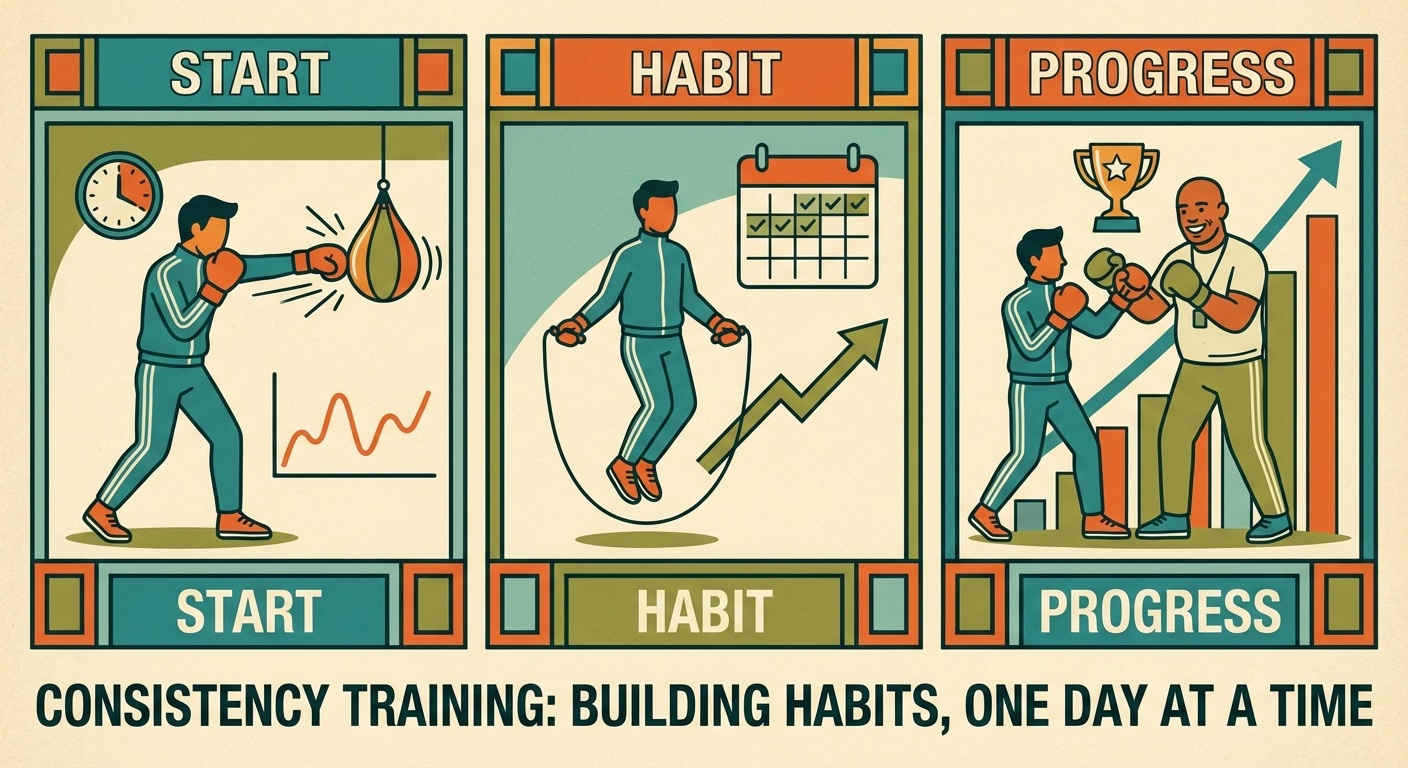
Build In Accountability
Join classes rather than exercising alone. Get a training partner. Tell people about your commitment. Anything that creates external expectation helps.
At a boxing gym, coaches know your name. They notice when you do not show up. Other members recognise you. This social accountability is powerful and free.
Expect Bad Weeks
Life intervenes. You will get ill, travel for work, have family emergencies. Bad weeks will happen. The question is whether you restart immediately or let a bad week become a bad month.
Plan for setbacks. Know that they are normal. Have a "minimum viable workout" that keeps the habit alive even when circumstances are terrible.
Track Something
Not obsessively, but enough to see progress. This might be sessions attended, skills learned, or how you feel. Humans respond to evidence of improvement. Without tracking, you have no data to counter the "this is not working" voice (source).
Why Boxing Helps With January
Boxing specifically addresses several common failure points:
- Coaching provides structure. You do not have to figure out what to do. Show up and the session is planned. This removes a major barrier.
- Classes create accountability. Your name's on the register. Coaches expect you. Other members notice. Social pressure works in your favour.
- Skill progression is visible. You are not just "exercising" - you are learning something. The progression from uncoordinated beginner to someone throwing proper combinations is tangible and satisfying.
- Sessions are varied. No two sessions are identical. This prevents the boredom that kills motivation for repetitive exercise.
- Community develops. Regular attendees become familiar faces. Training alongside the same people builds connection. This makes showing up enjoyable rather than a chore.
- It is really hard. This might seem counterintuitive, but easy exercise gets boring. Boxing is challenging in ways that engage rather than discourage. The difficulty creates respect for the activity.
The Eight-Week Test
Commit to eight weeks. Not forever, not a year's membership - eight weeks. That is roughly when habits start to solidify.
During those eight weeks:
- Train twice a week minimum, three times if possible
- Do not judge whether it is "working" until week six
- Expect awkwardness and struggle initially
- Focus on showing up, not on performance
After eight weeks, assess honestly. Are you better than you started? Do you sometimes look forward to training? Has something clicked?
If yes, keep going. If no, at least you gave it a real attempt and can try something else.
Practical January Advice
Start in the Second Week
The first week of January is chaos - people are still on holiday, schedules are disrupted, the emotional hangover from Christmas persists. Starting in week two, when normality resumes, gives better odds.
Book Sessions in Advance
Do not decide each day whether to go. Book a block of sessions in advance. Pre-commitment beats daily decision-making.
Tell Someone
Announce your intention to a friend, family member, or social media. Public commitment increases follow-through. It is harder to quietly quit when people expect updates.
Have a Plan for Bad Days
When you absolutely cannot train (ill, emergency, whatever), have a substitute. A 20-minute home workout, a long walk, something that maintains the habit even at reduced intensity.
Do not Wait Until Monday
"I will start properly on Monday" is a delay tactic. If today is Thursday and you have missed sessions, train today. The restart is immediate, not scheduled.
Try Boxing This January
The worst that happens: you spend a few weeks trying something new and decide it is not for you.
The best that happens: you find an activity that actually sticks, that you enjoy, that gets you fitter without feeling like punishment.
We offer free trial sessions with no commitment. Come in, experience a real boxing session, and see if it is something you could do long-term.
No sales pressure, no year-long contracts, no guilt trips. Just an honest opportunity to try boxing and make an informed decision.
H&G Team
Writer at Honour & Glory Boxing Club, a community boxing gym in Kidbrooke, South East London.
KEEP READING

Boxing for People Who Have Tried Every Other Fitness Class
The gym dropout rate is high because most fitness options do not sustain interest or motivation beyond the initial period. Boxing survives where other options do not. Here is why.

What Boxing Taught Me About Discipline
Discipline is discussed constantly in fitness culture and almost always described incorrectly. Boxing teaches it in a specific way that transfers to every other area of life.

The Boxing Quotes You Have Never Heard From Coaches
Everyone knows what Muhammad Ali said. Fewer people know what his trainer said. The coaches are where the real wisdom lives. Here are some of their best lines.
Was this page helpful?
It takes one tap, and it genuinely helps.
Choose your next step
Turn this article into the right action
Some readers are ready to book. Some need the class route first. Pick the route that matches what you actually want.