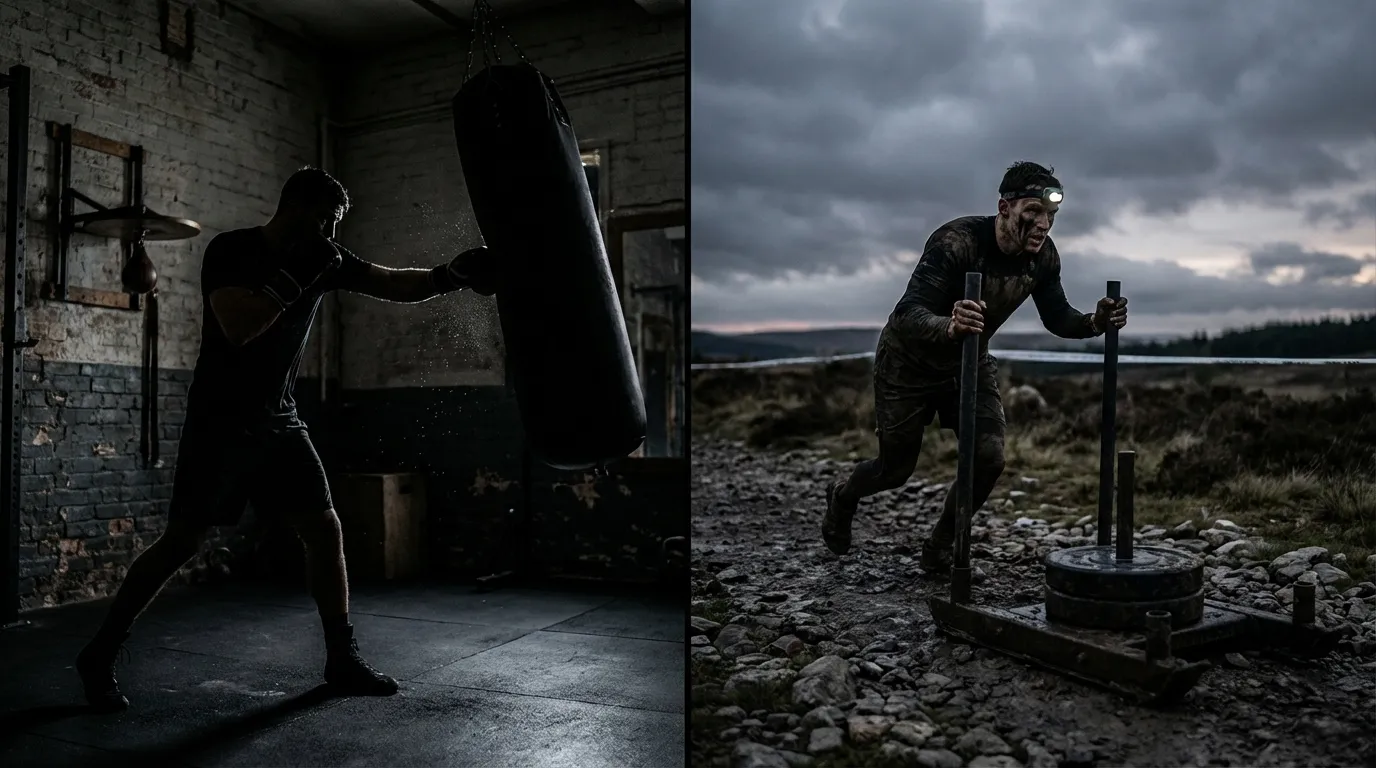
Hyrox official event data shows typical completion times and fitness benchmarks. England Boxing's participation data shows boxing growing at 43% year-on-year, significantly outpacing most functional fitness formats including Hyrox in the UK.
Hyrox has taken the fitness world by storm. The standardised race format has created a new tribe of "Hyrox athletes" training specifically for these hybrid running and functional fitness events. But how does Hyrox training stack up against boxing as a way to get fit?
Both build serious conditioning. Both attract people who want more than treadmill sessions. Let us break down what each offers and who they suit best.
What Exactly is Hyrox?
Hyrox is a fitness race format. Every race follows the identical structure worldwide:
- 8 x 1km runs
- Between each run, a functional fitness station
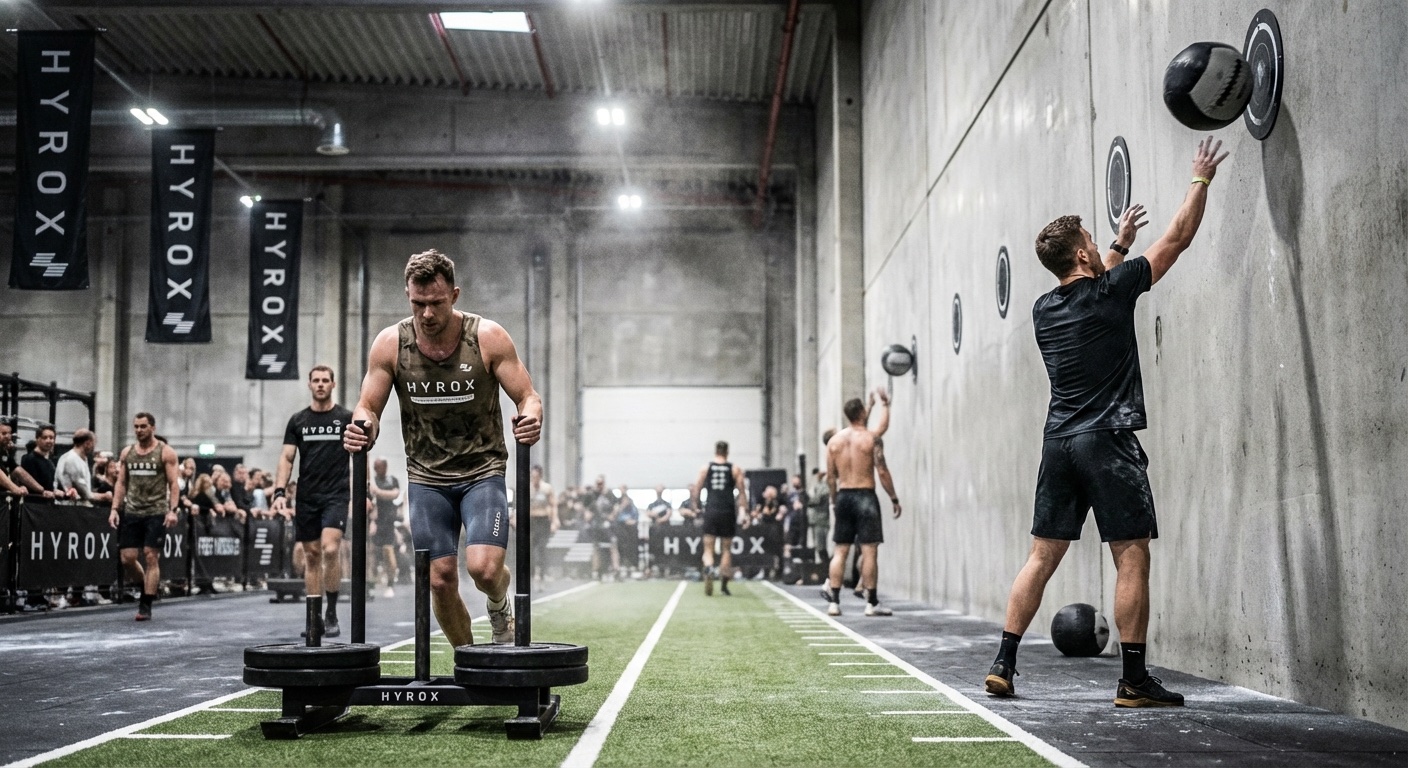
- Stations include: ski erg, sled push, sled pull, burpee broad jumps, rowing, farmers carry, sandbag lunges, wall balls
The standardised format means you can compare your time directly with anyone else who has ever raced Hyrox. This measurability is central to its appeal.
Training for Hyrox involves building the specific capacities the race demands - running endurance, grip strength, leg endurance for the sleds and lunges, upper body stamina for the ski erg and row.
What Does Boxing Training Involve?
Boxing training is not preparing you for a specific race format. It teaches you to box while getting you into excellent shape.
A typical session includes:
- Shadow boxing for technique and warm-up
- Bag work - combinations, power shots, conditioning rounds
- Pad work with a coach for timing and accuracy
- Partner drills for defence
- Conditioning work - skipping, circuits, core
The goal is developing boxing skill alongside fitness. You become a better boxer session by session while your conditioning improves as a byproduct.
Cardiovascular Conditioning
Both build substantial cardiovascular fitness, but in different ways.
Hyrox training develops primarily aerobic capacity with some anaerobic work. The race itself typically takes 60-90+ minutes of sustained effort. Training involves long zone 2 runs, tempo work, and practice sessions simulating race conditions.
The cardio is running-heavy. If you do not enjoy running, Hyrox training can feel like a slog. Running 8km per race (plus the stations) means putting in serious mileage during preparation.
Boxing training builds cardiovascular fitness through high-intensity interval work. Three-minute rounds of intense work followed by one-minute rest mirrors the demands of actual boxing. This naturally develops both aerobic and anaerobic systems.
The cardio comes packaged with skill work, so it rarely feels like pure cardio training. You are focused on technique, combinations, and timing - the fitness comes as a side effect.
Boxing builds what trainers call "repeatable power" - the ability to throw hard shots round after round without fading. This specific conditioning is different from the steady-state endurance Hyrox prioritises.
Strength Development
Hyrox requires functional strength for specific tasks:
- Grip strength for farmers carries and sled pulls
- Leg endurance for sled pushes and lunges
- Upper body stamina for ski erg and rowing
- Core stability throughout
The strength work is endurance-biased. You need to move moderate loads for sustained periods rather than lift maximum weights. Training typically includes moderate weight, high-rep schemes.
Boxing builds a different strength profile:
- Rotational power through the core
- Shoulder endurance for keeping hands up
- Explosive leg drive for power punches
- Posterior chain strength for solid stance
Boxing strength is about generating force quickly and repeatedly. The power to throw a proper hook comes from the legs and hips rotating, not from arm strength. This develops functional, athletic strength patterns.
Neither boxing nor Hyrox builds maximum strength like powerlifting would. Both prioritise power-endurance and work capacity over raw force production.
Skill Development
This is where the two diverge significantly.
Hyrox skills are accessible. The movements - running, rowing, pushing sleds - do not require years to learn. Within a few sessions, you can execute everything in a Hyrox race. The challenge is fitness, not technique.
This low skill barrier makes Hyrox accessible. Anyone reasonably fit can complete a race after 8-12 weeks of focused training.
Boxing skills take years to develop. The jab alone has layers of refinement - timing, distance, snap, setups, feints. Defence requires drilling until reactions become automatic. Footwork patterns need thousands of repetitions.
This depth is a double-edged sword. The learning curve is longer, but the journey is more engaging for many people. You are not just exercising - you are acquiring a genuine ability. Each session teaches you something new. The technical progression keeps training interesting for years.
Competition and Measurement
Hyrox is built around competition. Every race produces a time you can compare globally. Training naturally involves benchmark workouts you can repeat and track.
This measurability motivates many people. You see your progress clearly. You know exactly where you stand. Race results create concrete goals.

Boxing is less measurable for recreational practitioners. You cannot easily quantify improvements in technique, timing, or defensive reactions. Progress is often felt rather than measured.
If you compete, you have outcomes - wins and losses. But most recreational boxers never step into a competitive ring. Improvement comes through coach feedback, sparring observations, and the gradual realisation that things you used to struggle with now feel natural.
This lack of measurement suits people who do not need external validation but frustrates those who want numbers.
Injury Risk
Hyrox training carries risks common to endurance sports:
- Running injuries (knee, shin, plantar fascia)
- Shoulder issues from ski erg and rowing volume
- Lower back strain from sled work
- Grip-related problems
The combination of running mileage and repeated functional movements can accumulate stress. Many Hyrox athletes deal with overuse issues.
Boxing training has different risks:
- Hand and wrist injuries from improper technique
- Shoulder strain from bag work
- Knee issues from pivoting
However, recreational boxing - without competition or sparring - has a relatively good injury profile. The varied movement patterns distribute stress rather than concentrating it. There is no external load causing form breakdown under fatigue.
If you train smart and learn proper technique, boxing is lower risk than its combat nature might suggest.
Time Requirements
Hyrox preparation requires significant time investment:
- Multiple running sessions per week
- Functional fitness station practice
- Full simulation workouts (90+ minutes)
To race well, expect 6-10 hours of training weekly for 8-12 weeks. The running volume alone demands considerable time.
Boxing training is more flexible:
- Two to three gym sessions per week is plenty for recreational training
- Sessions typically run 60-90 minutes
- Home work (shadow boxing, skipping) can supplement gym time
You can maintain excellent boxing fitness on less weekly time than Hyrox demands.
Social Aspects
Hyrox has grown a community of dedicated practitioners. Training groups, race day experiences, and shared suffering build connections. The standardised race format creates common ground with anyone else who does Hyrox.
Boxing gyms have their own community feel - often more diverse and less fitness-culture-focused. You train alongside people from all walks of life. The shared challenge of learning a difficult skill creates bonds.
Both offer social motivation, though the cultures differ.
Who Should Choose Which?
- You enjoy running
- You want measurable, comparable results
- You like training for specific race events
- You want broad functional fitness
- Competition and PRs motivate you
- You already have a cardio base
- You want to learn an actual skill
- You prefer variety over running-heavy training
- You want stress relief (hitting things helps)
- You value practical self-defence ability
- You want intense workouts without running 8km
- You thrive on technical progression
Can They Work Together?
Yes, and they complement each other reasonably well.
Boxing develops upper body power-endurance and high-intensity work capacity that transfers to Hyrox. The repeated explosive efforts of bag work and pad work build conditioning useful for Hyrox stations.
Hyrox training builds the running base and steady-state endurance that boxing alone does not prioritise. Roadwork has always been part of boxing - Hyrox training formalises this.
A combined approach might look like:
- Two boxing sessions weekly for skill and high-intensity work
- Two Hyrox-style sessions for running and station practice
- One longer run for aerobic base
The main challenge is managing volume and recovery. Both are demanding. Over-training is possible if you go too hard at both.
The Bottom Line
Hyrox and boxing are both excellent training methods. Neither is objectively superior - they simply serve different purposes.
Hyrox offers a clear goal, measurable progress, and race-day experiences. It is accessible, community-oriented, and builds well-rounded functional fitness. If you love running and want something to train for, Hyrox delivers.
Boxing offers skill development, practical ability, and conditioning that comes packaged with learning something genuinely useful. The technical journey keeps training engaging for years. If pure fitness workouts bore you and you want to actually learn something, boxing provides depth that Hyrox cannot match.
H&G Team
The coaching and community team at Honour & Glory Boxing Club, a community boxing gym in Kidbrooke, South East London.
KEEP READING

Boxing Club vs Boxing Gym: Which Is Better?
Boxing club vs boxing gym explained clearly: coaching, atmosphere, safety, cost, beginners and who each option suits best.

Shadow Boxing vs CrossFit: Which Is Better?
Shadow boxing and CrossFit both build fitness, but they train different qualities. Here is when boxing, CrossFit, or a full boxing class makes more sense.

Boxing vs Running: Which Wins?
Compare boxing and running for fitness. Discover which cardio workout burns more calories, builds more muscle, and keeps you motivated long-term.
Was this page helpful?
It takes one tap, and it genuinely helps.
Choose your next step
Turn this article into the right action
Some readers are ready to book. Some need the class route first. Pick the route that matches what you actually want.